
Extreme Couponing vs. Casual Couponing: Weighing the Trade-Offs

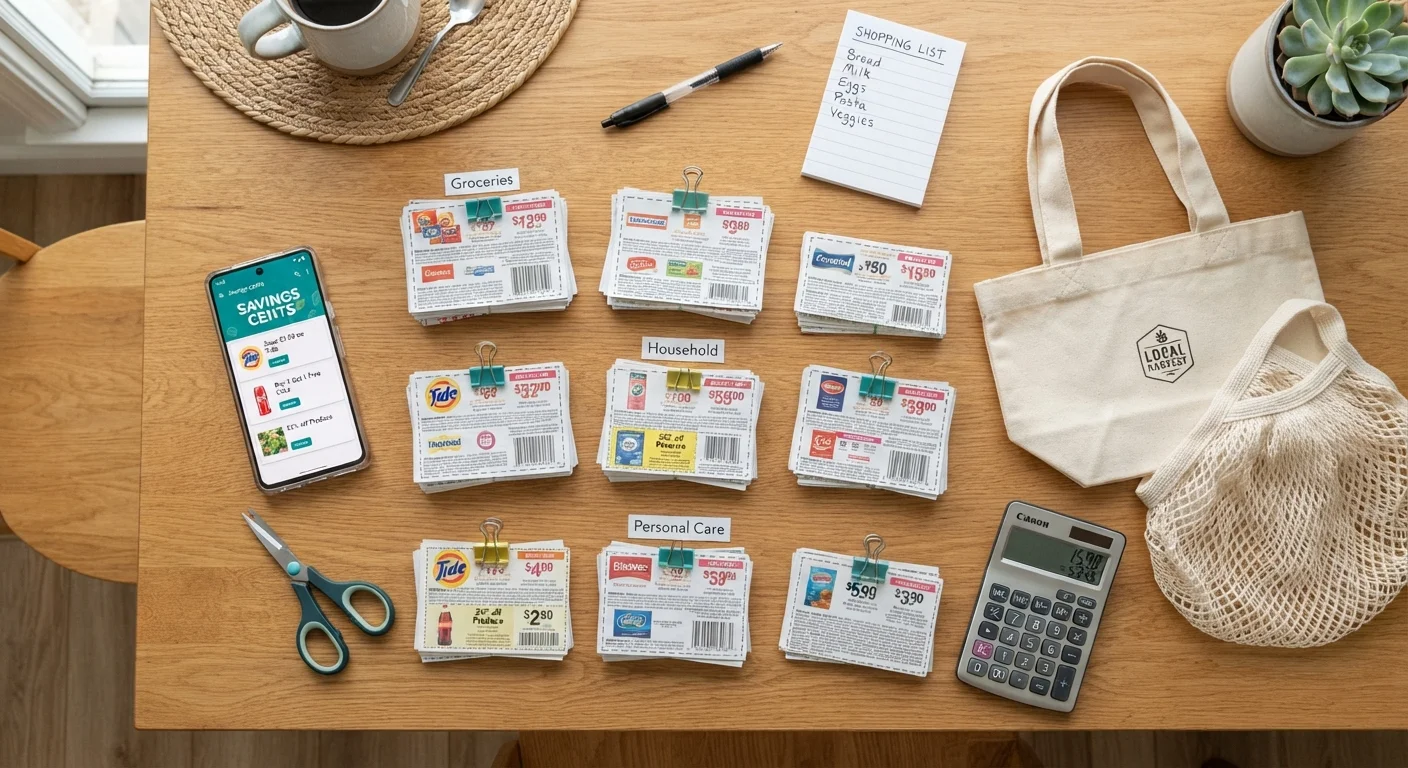
Photo: InsightsChief.com | Your Source Of Trusted Insights editorial
Key Takeaways
- Extreme couponing can yield large savings but requires significant weekly time investment and physical storage.
- Casual couponing delivers meaningful discounts with minimal effort, making it sustainable for most households.
- Coupon stacking - combining store and manufacturer coupons - is available to both approaches but has strict rules.
- The financial return per hour of effort often favors casual couponing for the average consumer.
- Neither approach guarantees savings if it leads to buying items you wouldn't otherwise purchase.
Potential for very large per-trip savings
Stacking manufacturer coupons with store sales and loyalty rewards can reduce the cost of specific goods by 40-70% or more in categories like packaged food and personal care.
Builds a useful long-term stockpile
Buying shelf-stable items at their lowest price point means you rarely pay full price, effectively locking in savings over months of future use.
Sharpens price literacy over time
Tracking sale cycles and coupon availability teaches shoppers the actual price floor for everyday products, making it harder for inflated "regular" prices to mislead.
Maximizes stacking opportunities
Extreme couponers are more likely to identify and correctly execute multi-layer deals - combining store coupons, manufacturer offers, and cashback apps on the same transaction.
Time investment is substantial
Serious extreme couponing routinely requires 10 or more hours per week to research deals, organize coupons, and plan shopping routes across multiple stores.
Requires significant physical storage space
Stockpiling dozens of units of a product demands shelving, climate control, and organizational systems that most households don't have readily available.
High risk of buying what you don't need
The pull of a high-value coupon can override genuine need, leading shoppers to spend money on products they wouldn't otherwise purchase - turning a "deal" into a loss.
Coupon policies are increasingly restrictive
Many major retailers have capped stacking, limited quantities per transaction, or tightened fraud-prevention rules, reducing the ceiling on savings that extreme methods can realistically achieve.
Expiration and waste risk
Stockpiles can expire before use, particularly for food items, converting apparent savings into outright waste - a risk that compounds when purchasing beyond genuine household capacity.
What Separates Extreme from Casual Couponing
Couponing exists on a spectrum. At one end, casual couponers clip or tap a handful of deals before a shopping trip - maybe spending 15 minutes scanning a store app or a browser extension. At the other end, extreme couponers treat deal-hunting as a part-time job: cross-referencing weekly circulars, tracking coupon databases, timing purchases to sale cycles, and sometimes spending 10 to 20 hours per week on the process.
The core mechanics are the same for both groups. Savings come from manufacturer coupons, store coupons, loyalty-program discounts, and - where permitted - stacking combinations of these. Before diving into either approach, it helps to understand coupon terms at a granular level; our guide to coupon fine print breaks down expiration windows, minimum purchase thresholds, and exclusion categories that catch many shoppers off guard.
The difference between the two styles is primarily about input - time, organization, and storage - relative to the savings output.
The Case for Extreme Couponing
When executed methodically, extreme couponing can produce dramatic reductions on a household's grocery and household-goods spending. Devotees often report cutting bills by 50% or more on specific shopping trips, particularly when stacking a manufacturer coupon with a store sale and a loyalty reward simultaneously.
Potential for very large per-trip savings
Stacking manufacturer coupons with store sales and loyalty rewards can reduce the cost of specific goods by 40-70% or more in categories like packaged food and personal care.
Builds a useful long-term stockpile
Buying shelf-stable items at their lowest price point means you rarely pay full price, effectively locking in savings over months of future use.
Sharpens price literacy over time
Tracking sale cycles and coupon availability teaches shoppers the actual price floor for everyday products, making it harder for inflated "regular" prices to mislead.
Maximizes stacking opportunities
Extreme couponers are more likely to identify and correctly execute multi-layer deals - combining store coupons, manufacturer offers, and cashback apps on the same transaction.
10-20 hrs
Weekly time extreme couponers typically invest
Consumer behavior researchers and couponing communities consistently report this range as typical for shoppers pursuing deep-discount stacking strategies.
~$1,800
Estimated average annual coupon savings per household
Industry estimates from coupon clearinghouses suggest moderate coupon users can save around $1,500-$2,000 annually, though results vary widely by category and effort level.
However, these headline numbers require important caveats. Large savings figures typically apply to specific product categories - shelf-stable foods, personal-care items, cleaning supplies - where coupon availability is highest. They also assume the shopper had the storage space and will actually use 40 bottles of shampoo before expiration. Extreme couponing also pairs naturally with knowledge of retail markdown cycles; see our seasonal shopping calendar for timing guidance that applies regardless of couponing intensity.
The Hidden Costs of Going Extreme
The trade-offs of extreme couponing are real and often underestimated.
Time investment is substantial
Serious extreme couponing routinely requires 10 or more hours per week to research deals, organize coupons, and plan shopping routes across multiple stores.
Requires significant physical storage space
Stockpiling dozens of units of a product demands shelving, climate control, and organizational systems that most households don't have readily available.
High risk of buying what you don't need
The pull of a high-value coupon can override genuine need, leading shoppers to spend money on products they wouldn't otherwise purchase - turning a "deal" into a loss.
Coupon policies are increasingly restrictive
Many major retailers have capped stacking, limited quantities per transaction, or tightened fraud-prevention rules, reducing the ceiling on savings that extreme methods can realistically achieve.
Expiration and waste risk
Stockpiles can expire before use, particularly for food items, converting apparent savings into outright waste - a risk that compounds when purchasing beyond genuine household capacity.
A particularly common pitfall is purchasing items solely because a coupon exists, not because they're needed. This erodes the actual savings. Our piece on couponing myths that cost shoppers real money addresses this in detail, including the misconception that coupon stacking is always permitted - many retailers have tightened policies significantly.
Stacking Rules Vary by Retailer
Casual Couponing: A Sustainable Middle Ground
Casual couponing skips the spreadsheets and bulk storage in favor of a leaner, habit-based approach. The core tools are store loyalty apps, digital coupon clips at checkout, and browser extensions that surface discount codes automatically for online purchases. For a comparison of the online tool landscape, see our overview of browser extensions vs. coupon websites.
Casual couponers also have format options worth considering. Printable vs. digital coupons each carry distinct quirks - digital coupons load directly to loyalty accounts and require no printing, while printable coupons sometimes carry higher face values but require more friction to redeem.
For households that find even light couponing too time-consuming, grocery budget strategies that don't involve coupons - such as meal planning, store-brand substitution, and unit-price comparison - can achieve comparable savings. More broadly, smart buying principles apply across categories whether coupons are in play or not.
Choosing the Right Intensity for Your Household
The right couponing approach is ultimately a personal calculus based on three variables: available time, available storage, and shopping discipline.
- Time: If you can realistically commit only 30 minutes per week to deal-hunting, a casual system will likely outperform an extreme system you can't maintain consistently.
- Storage: Bulk buying only generates savings if products are stored safely and used before expiration. Without adequate space, extreme stockpiling creates waste, not savings.
- Discipline: Both styles require the ability to walk away from a coupon when it doesn't align with actual household needs. Impulse buying triggered by a "deal" is a common way couponing generates net spending rather than net savings.
A reasonable benchmark: if casual couponing saves your household $20-$40 per month on items you'd buy anyway, it's succeeding. Chasing extreme-level savings with inadequate time or space rarely produces a better outcome - and can produce a worse one. For broader saving strategies that extend beyond the checkout lane, the saving strategies hub offers a wide range of complementary approaches.
This article is for general informational purposes only and does not constitute financial advice. Savings outcomes vary by individual shopping habits, region, and store policies.
The content provided on our blog site traverses numerous categories, offering readers valuable and practical information. Readers can use the editorial team’s research and data to gain more insights into their topics of interest. However, they are requested not to treat the articles as conclusive. The website team cannot be held responsible for differences in data or inaccuracies found across other platforms. Please also note that the site might also miss out on various schemes and offers available that the readers may find more beneficial than the ones we cover.