
The Anatomy of a Coupon: Terms, Restrictions, and Fine Print Decoded

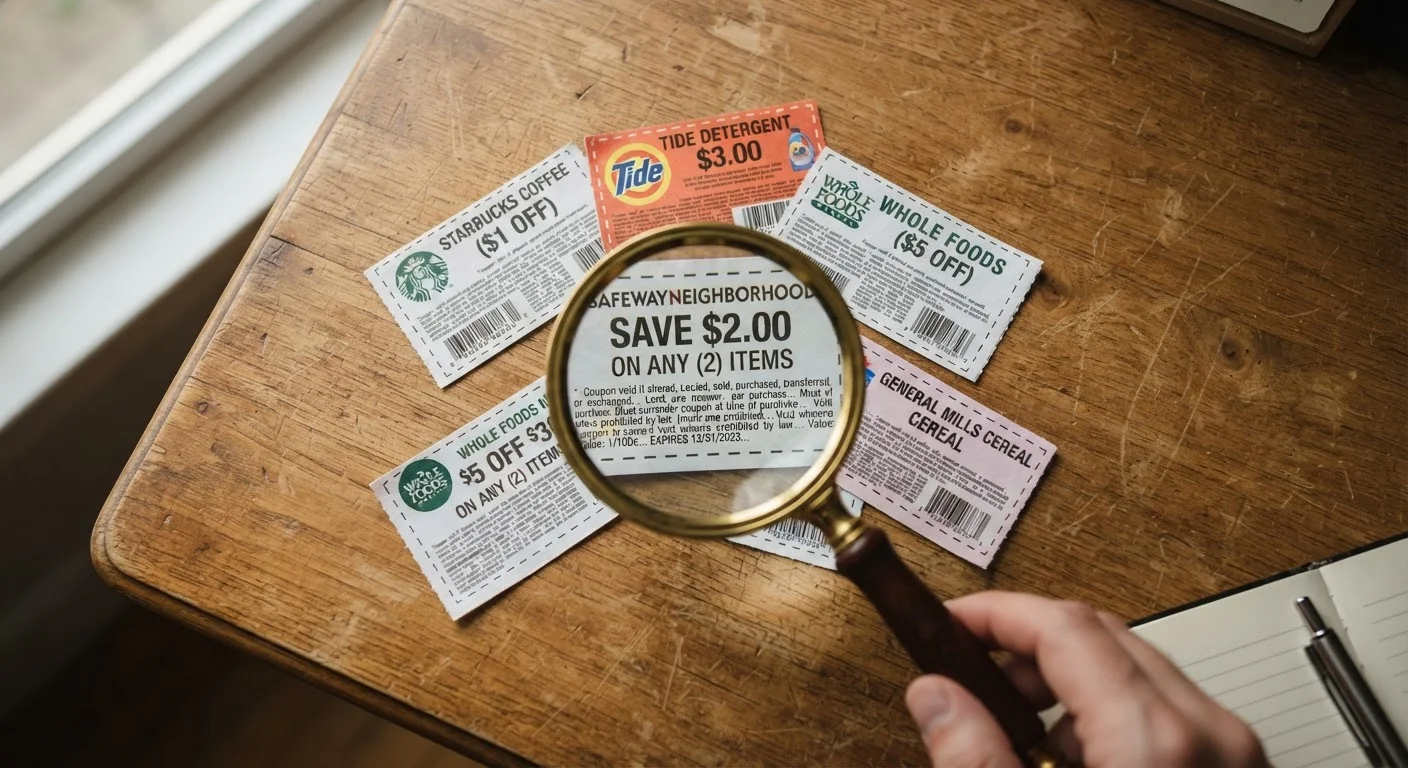
Photo: InsightsChief.com | Your Source Of Trusted Insights editorial
What Coupon Terms Actually Mean
Every coupon is a mini-contract between the issuer and the shopper. Understanding its terms prevents disappointment at checkout - and helps you spot when a deal is genuinely good versus misleadingly worded. The most consequential clauses appear in small text, but their impact is anything but small.
| Most common minimum threshold | Minimum spend requirement (e.g., "$25 or more") |
| Typical expiration interpretation | Invalid beginning the day after the printed date |
| Common stacking rule | One manufacturer + one store coupon per item (where permitted) |
| Digital coupon tracking | Often enforced automatically via loyalty account |
| Channel restrictions apply to | In-store, online, and app-specific coupons |
Start with the offer description, which defines what discount applies and to what. "$5 off your purchase" and "$5 off any one item" are different offers. The first typically applies to your entire basket; the second applies only to a single qualifying product, usually the lowest-priced eligible one if the rule is ambiguous.
The qualifying purchase requirement sets conditions you must meet. This may be a minimum dollar threshold ("spend $30 or more"), a minimum quantity ("buy 2"), or a specific product category ("on any refrigerated item"). Failing to meet these conditions means the coupon won't apply - and cashiers or checkout systems will reject it automatically. See our pre-shopping coupon checklist to verify qualifying conditions before you head to the store.
Exclusions, Restrictions, and Stacking Rules
Exclusion clauses are where most coupon frustration originates. Phrases like "excludes clearance," "not valid on sale items," or "excludes gift cards, alcohol, and pharmacy items" define product or category carve-outs. Even if a product appears to qualify based on the headline offer, exclusions printed elsewhere in the terms override it.
Qualifying Purchase
The minimum conditions - in spend, quantity, or product type - that must be met before a coupon discount can be applied. If the qualifying threshold isn't reached, the coupon is void for that transaction.
Exclusion Clause
Fine print that removes specific products, categories, or departments from eligibility. Exclusion clauses override the headline offer description and are strictly enforced at most registers and checkout systems.
Coupon Stacking
Using more than one coupon or discount on the same item or order simultaneously. Whether stacking is permitted depends entirely on the retailer's policy and the coupon issuer's terms.
Redemption Limit
A cap on how many times a coupon can be used - per customer, per household, or in total across all shoppers. Digital coupons often enforce this automatically through account tracking.
Channel Restriction
A term specifying where a coupon may be redeemed - in-store only, online only, or through a specific mobile app. Using a coupon in the wrong channel will result in rejection.
Manufacturer Coupon
A discount issued by the product's manufacturer rather than the retailer. These can typically be used at any store carrying the product and are sometimes combinable with store coupons.
One coupon per transaction is a common restriction that limits how many of the same coupon can be used in a single purchase. It does not necessarily prohibit combining a manufacturer coupon with a store coupon on the same item - those are different offer types. For a deeper look at how those two coupon categories interact, see how manufacturer and store coupons differ.
Stacking refers to applying more than one discount to the same item or order. Some retailers explicitly permit stacking a store coupon on top of a manufacturer coupon; others prohibit any combination. Promo codes entered at online checkout are frequently restricted to one code per order, so knowing a retailer's policy before you search for additional codes saves time. The complete coupon playbook covers stacking strategies in full detail.
Watch for channel restrictions: a coupon distributed in-store may explicitly state "in-store use only" and not be honored online, and vice versa. Mobile app coupons often require the app to be open at time of scan.
Expiration Dates and Redemption Limits
Expiration dates are straightforward in theory but tricky in practice. Most coupons expire at the end of the printed date - meaning a coupon marked "expires 06/30" is typically invalid beginning July 1, not at the end of June 30. Confirm the retailer's specific policy, as some interpret this differently.
Redemption limits are less visible but equally important. A coupon may be valid for only one use per customer, per household, or per email address. Digital coupons tied to a loyalty account often track usage automatically and deactivate after the first redemption. Print-at-home coupons may carry a unique barcode that becomes invalid after one scan.
Some offers carry a total redemption cap - a maximum number of uses across all shoppers - after which the code stops working even if it hasn't expired. This is common with promotional codes distributed by retailers during sales events. Pairing coupon use with cashback and rewards programs can extend your savings even after a coupon's redemption window closes.
For a full framework on applying these concepts before every shopping trip, the Smart Buying Tips hub provides practical strategies across every purchase category.
This article is for general informational purposes only. Coupon terms vary by issuer and retailer; always verify current terms directly with the applicable source before purchasing.
The content provided on our blog site traverses numerous categories, offering readers valuable and practical information. Readers can use the editorial team’s research and data to gain more insights into their topics of interest. However, they are requested not to treat the articles as conclusive. The website team cannot be held responsible for differences in data or inaccuracies found across other platforms. Please also note that the site might also miss out on various schemes and offers available that the readers may find more beneficial than the ones we cover.