
Keeping Up With Maintenance Yourself: What's Gained and What's Risked

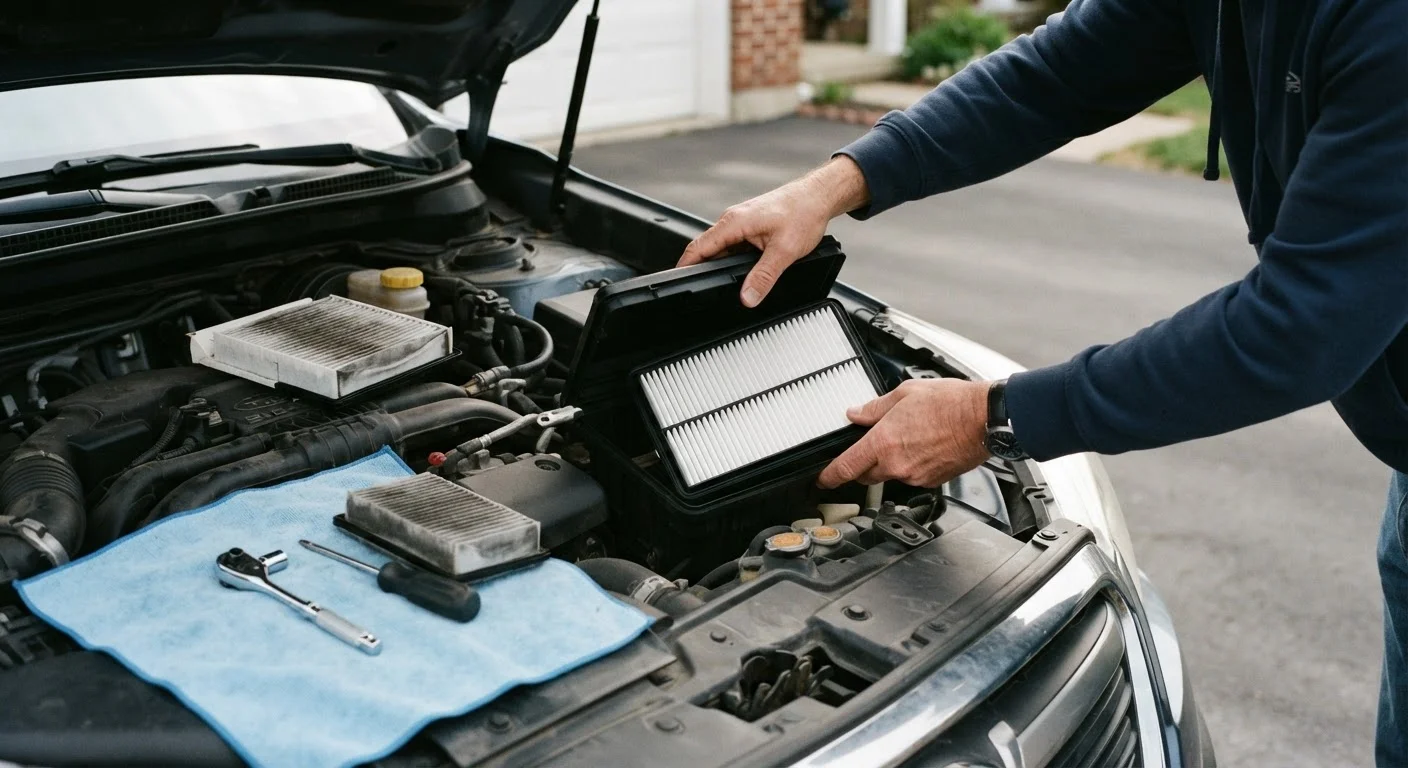
Photo: InsightsChief.com | Your Source Of Trusted Insights editorial
Key Takeaways
- DIY maintenance can eliminate labor costs, which often represent 50% or more of a shop invoice.
- Mistakes on the wrong job can cause more damage than the original service would have cost.
- Tasks like oil changes and air filter swaps suit most beginners; brake and suspension work generally does not.
- Proper documentation of self-performed maintenance still matters for warranty and resale purposes.
- Tools and supplies represent a real upfront investment that should factor into any cost comparison.
Eliminates labor charges on straightforward services
Labor commonly represents 50-70% of a routine service invoice. Performing an oil change, filter swap, or battery replacement yourself removes that cost entirely, leaving only the price of parts and supplies.
You control the quality of parts used
When you source your own parts, you choose the specification and quality tier rather than accepting whatever the shop stocks. This matters for things like oil grade, filter brand, or wiper quality.
Builds mechanical familiarity with your vehicle
Regularly working on your own car makes you more likely to notice early warning signs - unusual wear patterns, fluid discoloration, or component condition - before they escalate into larger problems.
Flexible scheduling on your timeline
DIY work can be done on a weekend without waiting for a shop appointment, which can be particularly useful in busy periods or when a service is due on short notice.
Satisfaction and skill-building over time
Each completed service increases competence and confidence, expanding the range of tasks you can handle safely - which compounds the cost savings over years of ownership.
Mistakes on safety-critical jobs can be dangerous
Improperly installed brake components or incorrectly torqued wheel lug nuts can create serious safety hazards. These are not situations where trial and error is an acceptable learning method.
Diagnostic errors can multiply the original cost
Without professional equipment, it's easy to misdiagnose a symptom and replace the wrong part. Buying unnecessary components - then still needing a shop visit - erases any savings quickly.
Upfront tool costs are real
A basic set of tools - floor jack, stands, torque wrench, drain equipment - can cost $150 or more to acquire, which affects the payback math for drivers who service their vehicle infrequently.
Some warranties require documented professional service
Certain manufacturers or extended service contracts specify that maintenance must be performed at an authorized facility and documented accordingly. DIY work may not satisfy those terms - always verify before proceeding.
Used oil and fluids require responsible disposal
Most auto parts retailers accept used motor oil at no charge, but you are responsible for safe handling and transport. Improper disposal of automotive fluids carries environmental and legal consequences.
Time investment is often underestimated
A professional mechanic completes routine tasks efficiently using purpose-built lifts and tools. The same job can take a first-timer two to three times as long, particularly if complications arise.
Where the Money Actually Goes at a Shop
Before deciding whether to do maintenance yourself, it helps to understand what you're actually paying for when you hand over your keys. A typical shop invoice breaks down into two categories: parts and labor. Labor rates at independent shops commonly range from $80 to $130 per hour; dealerships and specialty shops often charge more. On many routine services, labor accounts for more than half the total bill.
That markup structure is why some tasks look so appealing to DIY. An oil change requiring $35 in supplies can carry a $40-$60 labor charge at a shop. A cabin air filter that costs under $20 in parts may be billed out at $50-$80 once installation time is added. Understanding this split helps you identify which jobs offer real savings and which are priced so reasonably at shops that doing them yourself barely moves the needle. For a deeper look at how those numbers are structured, see how labor rates and parts markups work.
The Genuine Advantages of Doing It Yourself
When the job is appropriate for a non-specialist, self-performed maintenance offers real, measurable benefits.
Eliminates labor charges on straightforward services
Labor commonly represents 50-70% of a routine service invoice. Performing an oil change, filter swap, or battery replacement yourself removes that cost entirely, leaving only the price of parts and supplies.
You control the quality of parts used
When you source your own parts, you choose the specification and quality tier rather than accepting whatever the shop stocks. This matters for things like oil grade, filter brand, or wiper quality.
Builds mechanical familiarity with your vehicle
Regularly working on your own car makes you more likely to notice early warning signs - unusual wear patterns, fluid discoloration, or component condition - before they escalate into larger problems.
Flexible scheduling on your timeline
DIY work can be done on a weekend without waiting for a shop appointment, which can be particularly useful in busy periods or when a service is due on short notice.
Satisfaction and skill-building over time
Each completed service increases competence and confidence, expanding the range of tasks you can handle safely - which compounds the cost savings over years of ownership.
Keeping your own records also becomes easier when you perform the work. You know exactly what product went in, when, and at what mileage - information that matters for warranty purposes and resale value. A consistent paper trail, even for DIY work, pays dividends later. Our guide on keeping maintenance records explains why that history matters more than most drivers realize.
The Real Risks You Should Weigh First
Self-maintenance has a flip side, and honesty about those risks is what keeps a money-saving habit from becoming an expensive setback.
Mistakes on safety-critical jobs can be dangerous
Improperly installed brake components or incorrectly torqued wheel lug nuts can create serious safety hazards. These are not situations where trial and error is an acceptable learning method.
Diagnostic errors can multiply the original cost
Without professional equipment, it's easy to misdiagnose a symptom and replace the wrong part. Buying unnecessary components - then still needing a shop visit - erases any savings quickly.
Upfront tool costs are real
A basic set of tools - floor jack, stands, torque wrench, drain equipment - can cost $150 or more to acquire, which affects the payback math for drivers who service their vehicle infrequently.
Some warranties require documented professional service
Certain manufacturers or extended service contracts specify that maintenance must be performed at an authorized facility and documented accordingly. DIY work may not satisfy those terms - always verify before proceeding.
Used oil and fluids require responsible disposal
Most auto parts retailers accept used motor oil at no charge, but you are responsible for safe handling and transport. Improper disposal of automotive fluids carries environmental and legal consequences.
Time investment is often underestimated
A professional mechanic completes routine tasks efficiently using purpose-built lifts and tools. The same job can take a first-timer two to three times as long, particularly if complications arise.
Warranty Documentation Still Applies to DIY Work
One often-overlooked cost: the tool investment. A floor jack, jack stands, torque wrench, and oil drain pan represent a real upfront expense. For someone doing maintenance once or twice a year, the payback period may be longer than expected. Factor this in before assuming immediate savings.
Which Tasks Suit DIY - and Which Don't
The clearest framework for deciding is to separate tasks by consequence of error. Low-consequence tasks - where a mistake is obvious, correctable, and unlikely to cause injury or downstream damage - are generally appropriate for careful beginners. High-consequence tasks, where an error could compromise vehicle safety or cause significant mechanical damage, are better left to professionals unless you have solid experience.
Generally DIY-appropriate:
- Engine air filter and cabin air filter replacement
- Wiper blade replacement
- Oil and oil filter changes (with proper disposal of used oil)
- Battery replacement on most vehicles
- Checking and topping off fluids
Approach with caution or defer to a professional:
- Brake pad and rotor replacement (safety-critical; improper installation is dangerous)
- Suspension and steering components
- Timing belt or timing chain service
- Transmission fluid changes on vehicles with sealed units
- Any work requiring computer reprogramming or calibration
For a more detailed decision framework, our guide on DIY vs. shop decisions walks through common jobs with specific guidance on where the line sits.
The Cost of Skipping Maintenance Entirely
One risk worth naming separately: the temptation to skip a service entirely when it feels inconvenient or expensive - whether at a shop or as a DIY task. Deferred maintenance compounds. A $15 air filter left past its service interval can contribute to fuel economy losses and, in some cases, engine contamination over time. Skipped oil changes are among the most common contributors to premature engine wear.
DIY is only a money-saver when the maintenance actually gets done. If self-reliance leads to postponing services that would have been completed at a shop, the net result may be worse. Deferred maintenance and its compounding costs is a dynamic worth understanding before choosing any maintenance approach. For drivers aiming at long-term reliability, see the complete guide to keeping a car running reliably for 200,000 miles.
This article provides general information for educational purposes only and is not a substitute for advice from a qualified mechanic. Automotive systems vary by vehicle; always consult your owner's manual and, where safety systems are involved, a licensed professional.
The content provided on our blog site traverses numerous categories, offering readers valuable and practical information. Readers can use the editorial team’s research and data to gain more insights into their topics of interest. However, they are requested not to treat the articles as conclusive. The website team cannot be held responsible for differences in data or inaccuracies found across other platforms. Please also note that the site might also miss out on various schemes and offers available that the readers may find more beneficial than the ones we cover.