
Keeping Maintenance Records: Why the Paper Trail Matters More Than You'd Expect

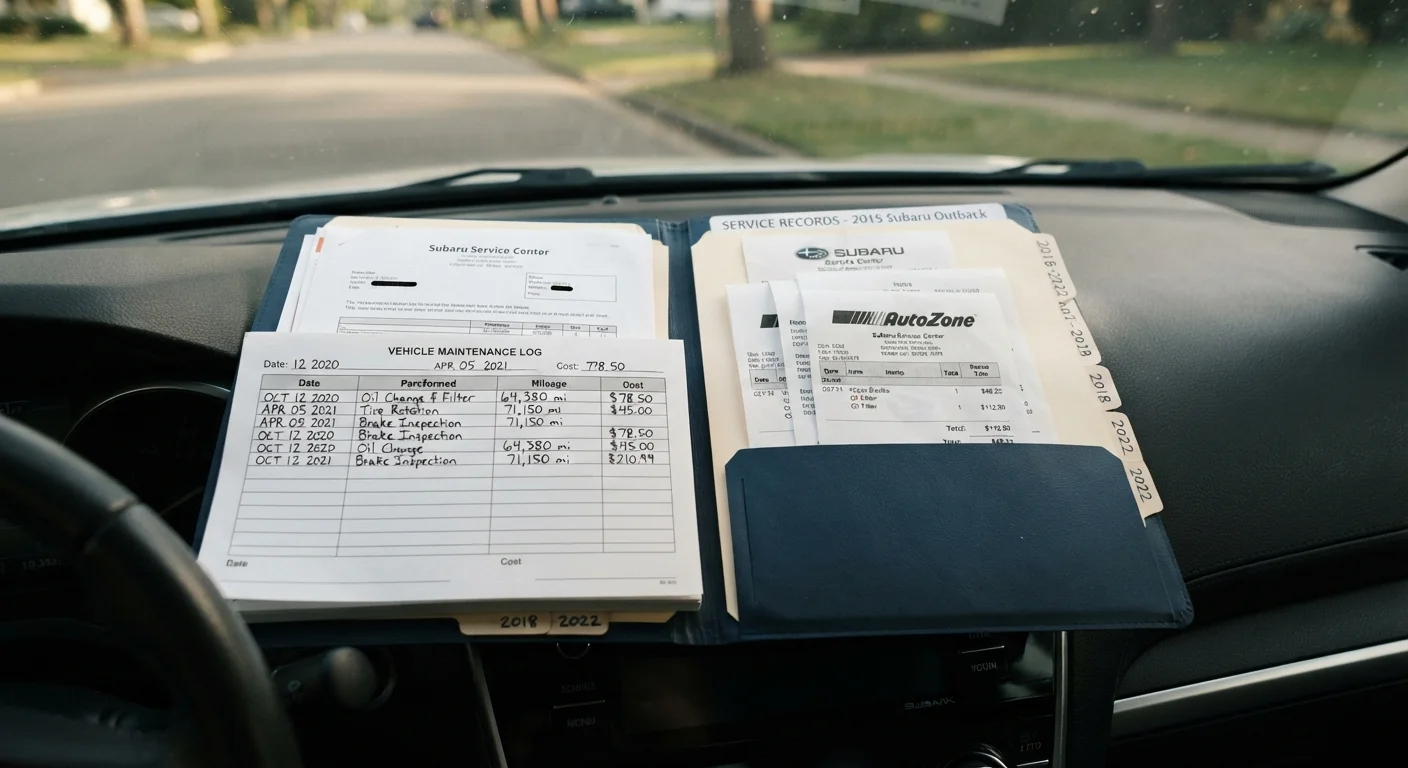
Photo: InsightsChief.com | Your Source Of Trusted Insights editorial
Key Takeaways
- A documented service history can meaningfully increase resale value by demonstrating consistent, verifiable care.
- Complete records help mechanics diagnose recurring issues faster, potentially reducing diagnostic labor costs.
- Warranty claims - both manufacturer and extended - are far easier to support with timestamped service documentation.
- Digital and paper systems both work; consistency and completeness matter more than format.
- Even DIY maintenance should be logged with dates, mileage, and parts used to count as credible history.
Why Maintenance Records Are a Financial Asset
Most drivers think of service records as paperwork - something the shop hands back and you toss in the glove box. In practice, that folder is closer to a financial instrument. When it comes time to sell or trade in a vehicle, a verifiable service history is one of the few things that clearly separates your car from an identical model with an unknown past.
Private buyers and dealerships alike factor reliability confidence into the price they're willing to pay. A car with documented oil changes, brake inspections, and fluid replacements at consistent intervals signals lower risk. One without records - even if mechanically sound - forces buyers to assume the worst. The gap can translate to hundreds or even thousands of dollars at sale time, depending on the vehicle's age and mileage.
The same logic applies to extended warranty and roadside assistance claims. Many providers require proof that the vehicle was maintained according to the manufacturer's schedule before honoring a claim. Missing that paper trail can result in a denied claim, leaving you responsible for a repair the warranty was supposed to cover.
For a deeper look at the full scope of routine upkeep, see the first-time owner's maintenance primer - it covers what tasks matter most and how often they're needed.
~$500-$1,500
Estimated resale value boost from complete service records
Industry observers and used-car appraisers commonly cite documented maintenance history as one of the top factors affecting private-sale pricing, with the premium varying by vehicle age and mileage.
30%+
Warranty claims affected by maintenance documentation gaps
Extended warranty providers frequently cite lack of service documentation as a basis for claim denial; exact rates vary by provider and contract terms.
Best Practices for Building a Reliable Service History
The goal isn't perfection - it's consistency. A record system that you actually use beats an elaborate one you abandon after two months. Below are the practices that matter most.
Record every service event at the time it happens, not weeks later.
Include mileage on every entry, not just dates.
Keep physical receipts alongside digital logs.
Document DIY maintenance with the same rigor as shop work.
Note any unusual findings or recurring symptoms at each service.
Review your records before every scheduled service appointment.
Getting Started: Quick Actions You Can Take Today
If your records are sparse or nonexistent, don't let that stop you from starting now. A partial history is still better than none, and future buyers or mechanics will benefit from whatever you can provide going forward.
If you also maintain a home, similar documentation habits pay off there too. The home maintenance log guide covers a parallel approach for tracking household repairs and warranties.
For drivers committed to keeping a vehicle long-term, maintenance records become even more critical. The guide to reaching 200,000 miles reliably explains how documentation fits into a broader discipline of long-term vehicle care.
The content provided on our blog site traverses numerous categories, offering readers valuable and practical information. Readers can use the editorial team’s research and data to gain more insights into their topics of interest. However, they are requested not to treat the articles as conclusive. The website team cannot be held responsible for differences in data or inaccuracies found across other platforms. Please also note that the site might also miss out on various schemes and offers available that the readers may find more beneficial than the ones we cover.