
The Honest Trade-Offs of Working Out at Home Every Day

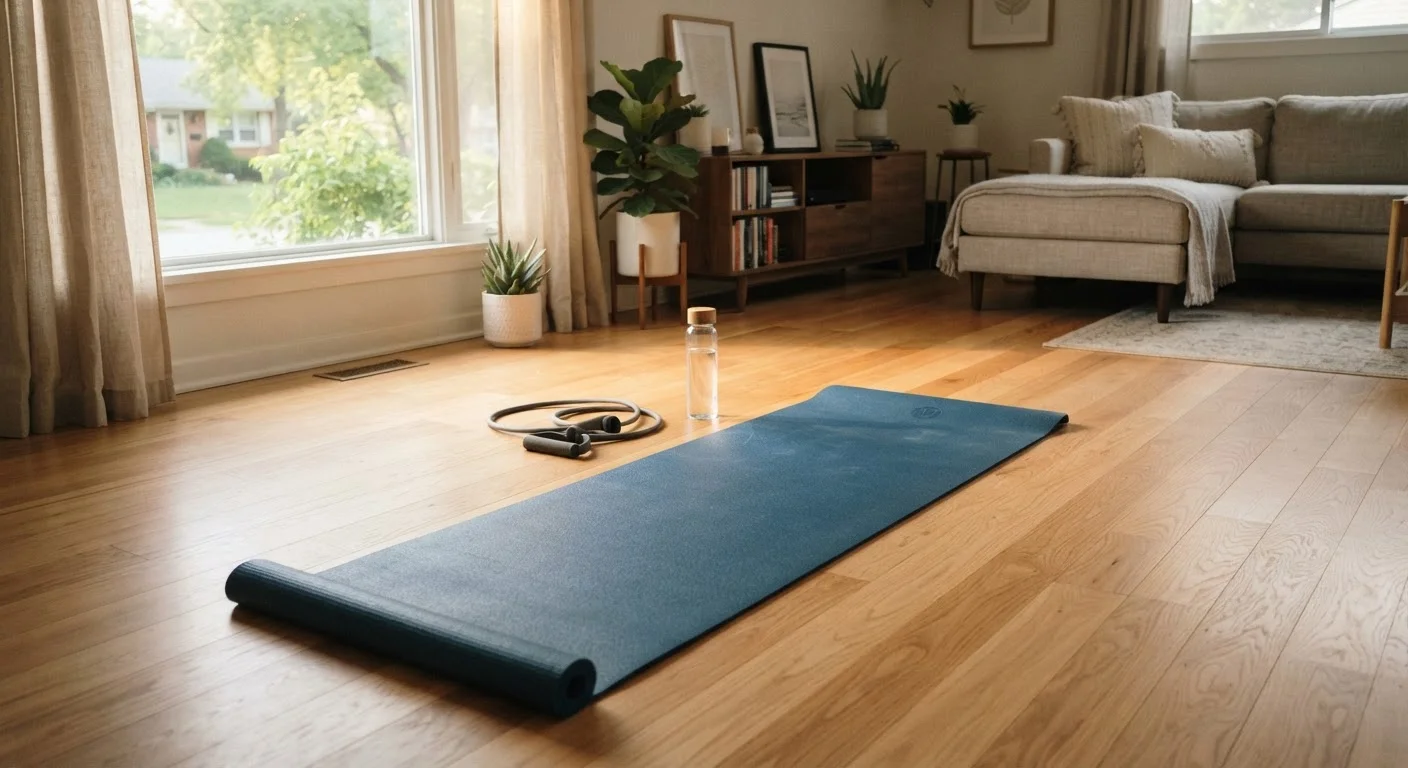
Photo: InsightsChief.com | Your Source Of Trusted Insights editorial
Key Takeaways
- Daily home workouts save money and commute time, making consistency more achievable for busy families.
- Without progressive overload and variety, home routines commonly plateau within weeks.
- Accountability and social motivation are harder to maintain without a gym or fitness community.
- Space and equipment limitations are real, but many can be worked around with bodyweight and minimal tools.
- Rest and recovery matter as much as the workouts themselves - daily training requires careful intensity management.
No commute, no membership fees
Eliminating gym travel and monthly dues removes two of the most common barriers to exercise. For households on a tight budget, this alone can make consistent training more sustainable long-term.
Flexible scheduling around family life
Home training can happen at 6 a.m. before the kids wake up or during a lunch break. That flexibility reduces the 'I can't get there in time' excuse that derails many gym-based routines.
Privacy reduces self-consciousness
Many beginners feel intimidated in public gym settings. Exercising at home removes that social pressure, which research suggests can lower barriers to starting and sticking with a routine.
Minimal equipment can still produce real results
Bodyweight movements - squats, push-ups, lunges, planks - have well-documented effectiveness for building strength and cardiovascular fitness. Resistance bands can add meaningful load without significant expense.
Habit stacks more easily into daily routine
Because the 'gym' is already there, home workouts can be paired with existing habits like morning coffee or the school run, making them easier to anchor into a consistent daily pattern.
Progress plateaus without structured overload
The body adapts to repeated stimuli, so doing the same bodyweight routine indefinitely stops producing results. Without understanding progression principles, many home trainers stall within a few weeks.
No coach means higher injury risk for beginners
Poor form on movements like deadlifts or lunges is harder to self-correct without expert feedback. Beginners working alone are more likely to develop compensatory movement patterns that cause overuse injuries over time.
Motivation is self-generated and can deplete
Gyms and group classes provide social reinforcement and external accountability. At home, those cues are absent, and motivation tends to erode during stressful periods when consistency matters most.
Space and equipment genuinely limit some training
Heavy compound lifts, certain cardio formats, and equipment-dependent modalities simply aren't replicable without space and investment. Families in small apartments face real physical constraints.
Daily training demands careful recovery management
Without adequate rest, daily workouts increase the risk of overtraining - a state characterized by persistent fatigue, declining performance, and elevated injury vulnerability. Intensity variation is essential, not optional.
Home environment contains distractions and interruptions
Children, household chores, notifications, and domestic noise can fragment sessions. Incomplete or distracted workouts may not deliver the stimulus needed for consistent adaptation.
Why the 'Just Work Out at Home' Advice Needs More Nuance
Home workouts are often presented as the obvious solution to every fitness barrier - no gym required, no excuses. That framing isn't entirely wrong, but it glosses over genuine complexity. Working out at home every day can be a sustainable, effective strategy, or it can quietly become a cycle of inconsistency, injury risk, and stalled progress - depending largely on how it's approached.
If you're considering daily home training, or already doing it and wondering why results have slowed, it helps to see both sides honestly. This isn't about discouraging you - it's about giving you the information to make it actually work. If you're just starting out, our beginner home fitness guide covers foundational principles worth reading alongside this piece.
The Real Advantages of Daily Home Training
The most compelling case for home workouts isn't convenience - it's the removal of friction. Every obstacle between you and exercise is a potential quit point. Commute time, membership costs, gym hours, childcare logistics - home training eliminates most of them.
No commute, no membership fees
Eliminating gym travel and monthly dues removes two of the most common barriers to exercise. For households on a tight budget, this alone can make consistent training more sustainable long-term.
Flexible scheduling around family life
Home training can happen at 6 a.m. before the kids wake up or during a lunch break. That flexibility reduces the 'I can't get there in time' excuse that derails many gym-based routines.
Privacy reduces self-consciousness
Many beginners feel intimidated in public gym settings. Exercising at home removes that social pressure, which research suggests can lower barriers to starting and sticking with a routine.
Minimal equipment can still produce real results
Bodyweight movements - squats, push-ups, lunges, planks - have well-documented effectiveness for building strength and cardiovascular fitness. Resistance bands can add meaningful load without significant expense.
Habit stacks more easily into daily routine
Because the 'gym' is already there, home workouts can be paired with existing habits like morning coffee or the school run, making them easier to anchor into a consistent daily pattern.
Consistency, not perfection, drives long-term fitness outcomes. A moderate workout done daily almost always outperforms an intensive gym session done sporadically. For families managing tight schedules, see how time-pressed households can structure activity effectively.
The Honest Drawbacks You Should Plan For
The disadvantages of daily home workouts aren't reasons to abandon the approach - they're problems to anticipate and design around. Ignoring them is what causes most home routines to quietly collapse after a few weeks.
Progress plateaus without structured overload
The body adapts to repeated stimuli, so doing the same bodyweight routine indefinitely stops producing results. Without understanding progression principles, many home trainers stall within a few weeks.
No coach means higher injury risk for beginners
Poor form on movements like deadlifts or lunges is harder to self-correct without expert feedback. Beginners working alone are more likely to develop compensatory movement patterns that cause overuse injuries over time.
Motivation is self-generated and can deplete
Gyms and group classes provide social reinforcement and external accountability. At home, those cues are absent, and motivation tends to erode during stressful periods when consistency matters most.
Space and equipment genuinely limit some training
Heavy compound lifts, certain cardio formats, and equipment-dependent modalities simply aren't replicable without space and investment. Families in small apartments face real physical constraints.
Daily training demands careful recovery management
Without adequate rest, daily workouts increase the risk of overtraining - a state characterized by persistent fatigue, declining performance, and elevated injury vulnerability. Intensity variation is essential, not optional.
Home environment contains distractions and interruptions
Children, household chores, notifications, and domestic noise can fragment sessions. Incomplete or distracted workouts may not deliver the stimulus needed for consistent adaptation.
The progression problem is particularly underappreciated. Many people restart the same beginner routine for months, wondering why they don't look or feel different. Understanding how progressive overload works at home is probably the single highest-leverage thing you can learn to fix this.
This is General Fitness Information
Making the Trade-Offs Work in Your Favour
The households that sustain daily home training long-term tend to share a few common habits. They vary intensity intentionally - mixing harder effort days with active recovery or mobility work - rather than pushing hard every single session. They treat their workout space as a dedicated zone, even if it's just a cleared corner, to limit environmental distractions.
They also stay honest about plateaus. If your routine stopped producing noticeable change, that's data, not failure. Understanding why home workouts stall can help you adjust before frustration sets in. And for those weighing whether a gym might serve some goals better, the research comparing both approaches offers a balanced perspective.
~30%
Adults meeting weekly physical activity guidelines
The CDC estimates that only around 24-28% of US adults meet both aerobic and muscle-strengthening guidelines - suggesting that any format that improves adherence has meaningful public health value.
0
Minimum equipment needed for effective bodyweight training
Exercise science research consistently shows that bodyweight resistance training can maintain and improve muscular strength and endurance without any equipment when programmed progressively.
Before every session, a brief safety check of your space and physical readiness matters more than most people realize. A practical pre-workout checklist can help you build that habit into your routine from the start.
This article is for general informational purposes only and does not constitute medical or fitness advice. Consult a qualified healthcare professional before starting any new exercise program, especially if you have existing health conditions or injuries.
The content provided on our blog site traverses numerous categories, offering readers valuable and practical information. Readers can use the editorial team’s research and data to gain more insights into their topics of interest. However, they are requested not to treat the articles as conclusive. The website team cannot be held responsible for differences in data or inaccuracies found across other platforms. Please also note that the site might also miss out on various schemes and offers available that the readers may find more beneficial than the ones we cover.