
Depreciation: The Ownership Cost Most Drivers Never See Coming

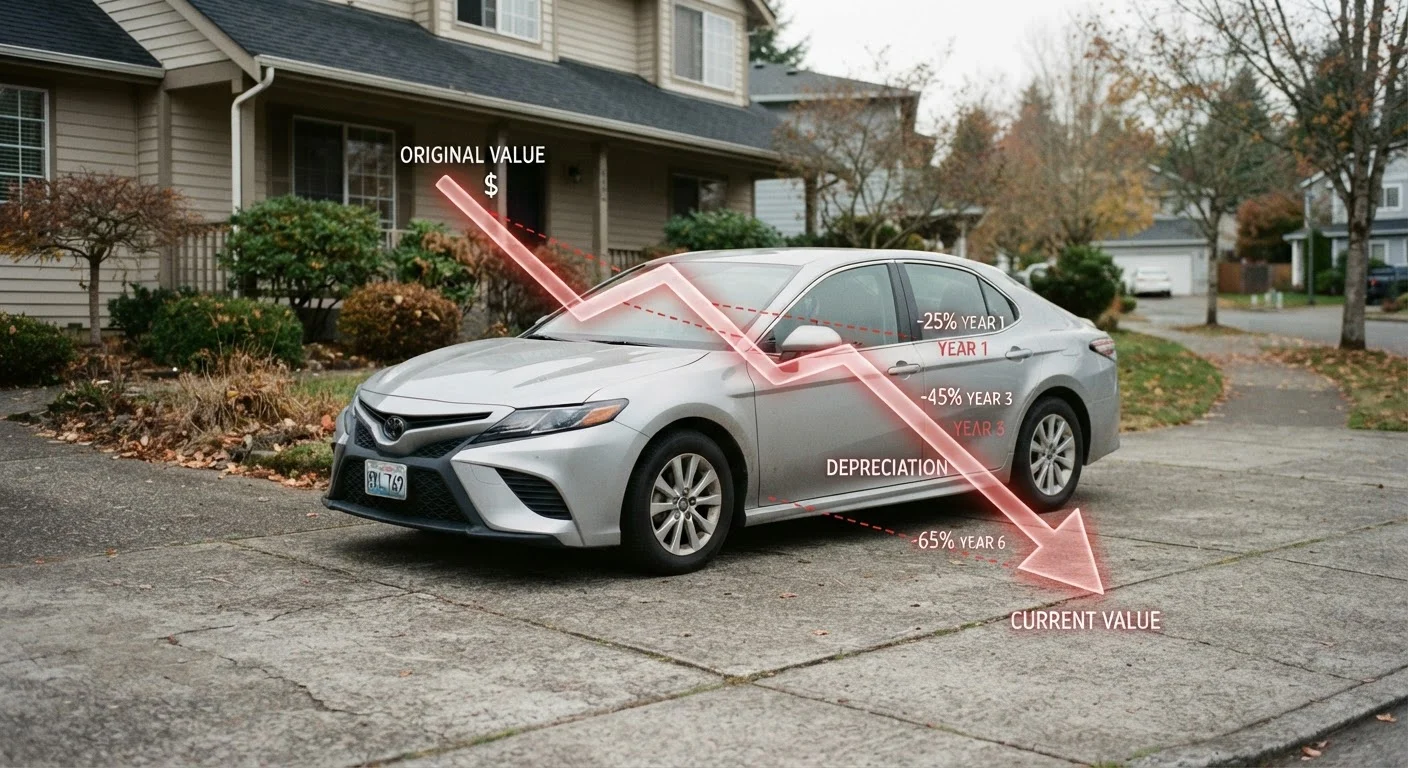
Photo: InsightsChief.com | Your Source Of Trusted Insights editorial
Key Takeaways
- Depreciation is typically the single largest component of new-car ownership costs.
- A new vehicle can lose roughly 20% of its value in the first year alone.
- The steepest depreciation occurs in years one through three of ownership.
- Buying a vehicle that is two to three years old lets someone else absorb the sharpest drop.
- Keeping a vehicle longer spreads depreciation costs over more miles and years.
- Depreciation doesn't appear on any bill - but it directly affects your total spending on transportation.
Why Depreciation Is an Invisible But Real Expense
Most car costs arrive as an invoice - a fuel receipt, an insurance premium, a repair bill. Depreciation doesn't. It accumulates silently in the background, and the only moment it becomes visible is when you sell or trade in your vehicle and see what it's actually worth. That invisibility is exactly why so many drivers are blindsided by it.
According to AAA's annual Your Driving Costs study, depreciation routinely ranks as the largest single ownership cost for new-vehicle buyers - often exceeding what drivers pay for fuel or insurance in the same period. For a broader view of every cost category involved in ownership, see our guide to the true annual cost of owning a car in the US.
~20%
Typical new-car value lost in year one
Industry estimates consistently place first-year depreciation for new vehicles at roughly 15-20% of purchase price, with variation by model and market conditions.
~50%
Cumulative value loss by end of year three
Many new vehicles lose close to half their original value within the first three years of ownership, according to commonly cited automotive research.
#1
Depreciation's rank among new-car ownership costs
AAA's annual Your Driving Costs study consistently identifies depreciation as the largest single cost category for new-vehicle owners.
When Depreciation Hits Hardest
Depreciation is not a steady, linear process. It front-loads: the loss is sharpest in the earliest years and gradually flattens as the vehicle ages.
- Year 1: A new vehicle commonly sheds 15-20% of its purchase price within the first twelve months, partly due to the gap between new-car retail pricing and used-car market pricing.
- Years 2-3: Value continues to fall at a meaningful rate, often bringing cumulative depreciation to 40-50% of the original purchase price by the end of year three.
- Years 4-6: The rate of loss slows considerably. A vehicle that has already absorbed the steepest decline loses a smaller percentage each subsequent year.
- Beyond year 6: Depreciation continues but at a much slower pace, and total value eventually stabilizes at a floor reflective of age and condition.
This curve is why the first owner of a new vehicle bears the greatest depreciation burden - and why buying a vehicle a few years into its life can shift that cost profile meaningfully.
How to Factor Depreciation Into Your Ownership Decisions
Understanding depreciation changes how you evaluate a vehicle purchase. A lower sticker price doesn't always mean lower total cost - a vehicle that loses value quickly can end up being more expensive over a five-year horizon than a pricier model that holds its value better.
A few practical ways to account for depreciation when making ownership decisions:
- Consider total cost of ownership, not just monthly payments. Financing costs and monthly payments are easy to see; depreciation requires deliberate calculation. Estimate what the vehicle is likely to be worth at your expected sale date and subtract that from your all-in purchase cost.
- Evaluate a used vehicle two to four years old. Letting the first owner absorb years one through three of depreciation is one of the most straightforward ways to reduce your exposure. Our article on new vs. used car ownership costs examines the full trade-offs.
- Plan to keep the vehicle longer. Spreading depreciation over eight or ten years instead of three or four lowers your average annual cost, assuming maintenance expenses remain manageable.
- Maintain the vehicle properly. Condition affects resale value. A well-maintained vehicle with complete service records will typically command a higher price than a neglected one of the same age and mileage. See our car maintenance hub for upkeep guidance.
Depreciation is also one of the cost assumptions drivers most commonly underestimate. Our article on ownership cost assumptions that cost drivers more covers this and related blind spots in more depth.
Calculate Depreciation Before You Buy
What Depreciation Doesn't Tell You
Depreciation rates vary significantly by vehicle segment, brand, and model - but past depreciation patterns are not a reliable guarantee of future residual values. Economic conditions, fuel prices, and shifts in consumer demand can all alter how quickly a particular vehicle loses value. Used-car market dynamics during supply disruptions, for example, have at times caused certain vehicles to retain value - or even temporarily appreciate - in ways that deviated sharply from historical norms.
The point is not to chase vehicles with the highest projected resale value as though it were certain. The point is to include depreciation as a line item in your cost calculations from the start, rather than discovering it only when you hand over the keys.
If you are new to thinking through vehicle ownership expenses, our introductory guide - Understanding Car Ownership Costs: A Starting Point for New Drivers - provides a structured overview of every cost category worth planning for before and after you buy.
Frequently Asked Questions
The content provided on our blog site traverses numerous categories, offering readers valuable and practical information. Readers can use the editorial team’s research and data to gain more insights into their topics of interest. However, they are requested not to treat the articles as conclusive. The website team cannot be held responsible for differences in data or inaccuracies found across other platforms. Please also note that the site might also miss out on various schemes and offers available that the readers may find more beneficial than the ones we cover.