
Store Brands vs. Name Brands: What the Research Actually Shows

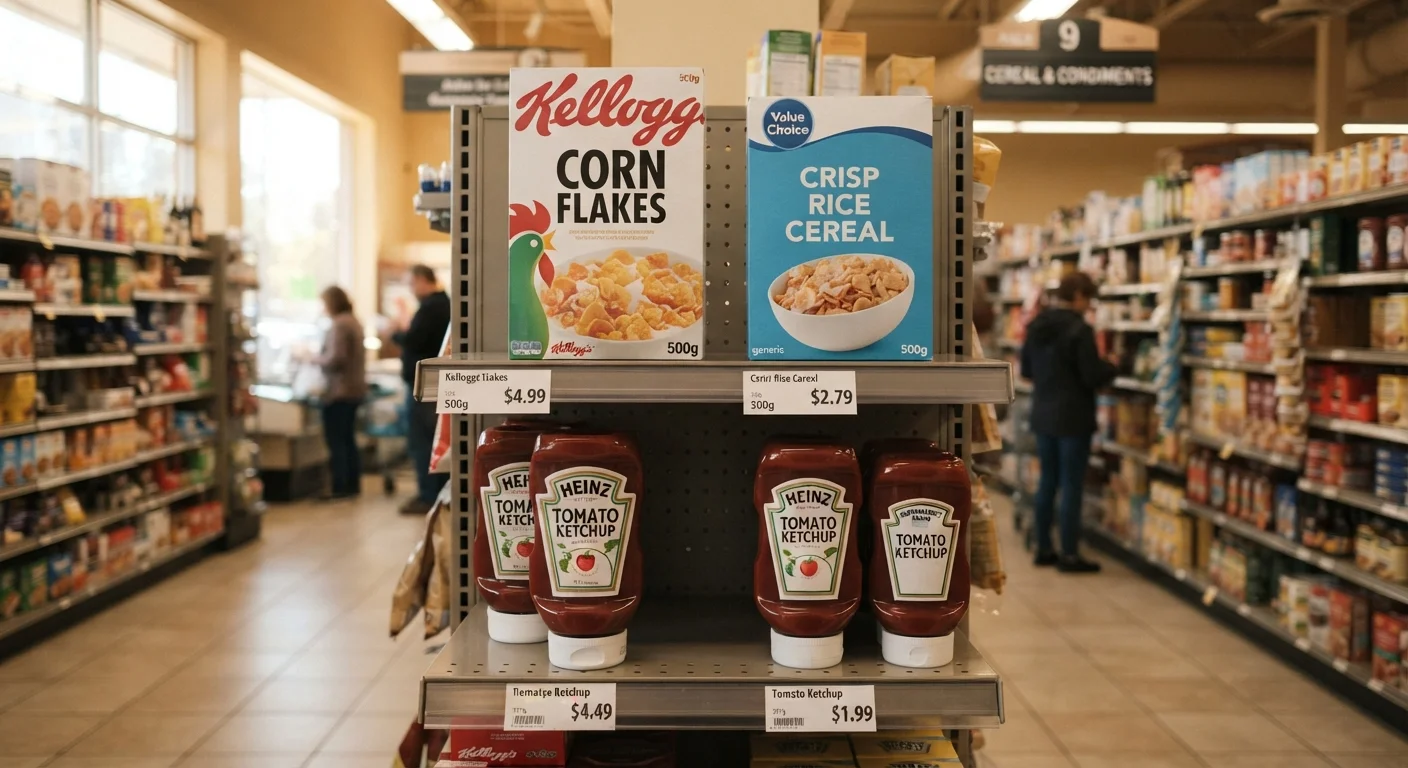
Photo: InsightsChief.com | Your Source Of Trusted Insights editorial
Key Takeaways
- Independent testing frequently finds store-brand products match name-brand quality in many categories.
- Some categories - including over-the-counter medications and pantry staples - show little measurable difference.
- Brand loyalty often reflects marketing exposure, not verified performance advantages.
- A category-by-category approach, rather than blanket rules, yields the best value decisions.
- Packaging, not formulation, is often what separates a private-label product from its branded equivalent.
The Research Landscape: What Independent Testing Shows
The most reliable evidence on store brand versus name brand quality comes from blind comparative testing - where evaluators don't know which product they're assessing. Consumer advocacy organizations have conducted this type of testing across food, household products, and personal care items for decades, and the pattern that emerges is consistent: product category matters far more than brand ownership.
In standardized food categories - cooking oils, canned tomatoes, dried pasta, white rice - store brands regularly receive equivalent or indistinguishable ratings. In categories requiring complex formulations or proprietary processes, results are more variable. The key insight is that the name-brand premium reflects a blend of R&D recovery, advertising costs, and retailer margin negotiation - not a guaranteed quality premium passed to the consumer.
Myth
Store-brand products are always lower quality than name brands.
Fact
Independent comparative tests routinely show store brands matching or outperforming name brands in many product categories.
Consumer testing organizations - including CR and academic food science research groups - have conducted blind sensory and laboratory analyses for decades. Their findings consistently show that in categories like canned vegetables, cooking oils, baking staples, and many cleaning products, private-label items perform at essentially the same level as nationally advertised brands. The quality gap, when it exists at all, varies significantly by category rather than being a blanket truth.
The reason is structural: many store-brand products are manufactured in the same facilities as their name-brand counterparts, sometimes on the same production line, with the same ingredients. Retailers simply relabel them under their own label at a lower margin.
Myth
Generic over-the-counter medications are less effective than brand-name drugs.
Fact
Generic OTC medications contain the same active ingredients in the same concentrations as their branded equivalents and must meet identical FDA standards.
In the United States, the FDA requires generic drugs - including over-the-counter versions - to be bioequivalent to the branded product. This means the active ingredient, dosage form, strength, and route of administration must be the same. What differs are inactive ingredients like fillers, dyes, and binders, which generally have no effect on therapeutic outcome for most people.
The price difference can be substantial. Generic OTC analgesics, antihistamines, and antacids are widely documented to cost significantly less while delivering the same pharmacological effect. Consumers paying premium prices for branded medications are largely paying for packaging and advertising, not efficacy.
[important_callout]Myth
Premium packaging signals a premium product inside.
Fact
Packaging design is a marketing decision, not a quality indicator - reformulation and ingredient sourcing determine actual product quality.
Retail and consumer psychology research shows that packaging significantly influences perceived quality before a product is ever used. Studies have found that identical products rated higher in blind taste tests when presented in upscale packaging - a well-documented placebo-style effect. Name brands invest heavily in packaging design precisely because it shifts perception without changing the product.
For shoppers trying to make evidence-based decisions, this means treating packaging as a signal of marketing investment, not product quality. A plain white label doesn't indicate inferior contents; it often reflects lower overhead costs being passed to the consumer. For a broader framework on evaluating products without relying on surface signals, see our product evaluation guide.
Myth
Store brands always use cheaper, lower-grade ingredients.
Fact
Ingredient sourcing for store brands varies widely by retailer and category; some private labels use identical ingredient specifications to the name-brand product.
Large grocery chains frequently negotiate ingredient sourcing agreements that mirror or match the specifications used by national brands - particularly for commodity items like flour, sugar, dried pasta, and canned goods where raw material standards are highly regulated. Retailers have reputational incentives to maintain quality, since a poor private-label experience can reduce overall store loyalty.
That said, ingredient quality is not uniform across all store-brand products or all retailers. Protein-heavy products, specialty items, and product categories requiring complex formulations may see more variability. The practical takeaway: checking the ingredient list and comparing it directly to the name-brand equivalent is more reliable than making assumptions based on brand status alone.
Myth
Choosing store brands always means making a compromise.
Fact
In many categories, choosing store brands is the financially rational decision with no meaningful trade-off in performance or safety.
The framing of store brands as a "compromise" reflects decades of brand marketing rather than independent evidence. For commodity staples, regulated products like pharmaceuticals, and categories with standardized production processes, the meaningful differences between private-label and name-brand products are often negligible. The real compromise may be defaulting to name brands without examining whether the price premium is justified.
That said, blanket store-brand loyalty has the same flaw as blanket name-brand loyalty - it replaces thinking with habit. Some categories genuinely show performance differences. High-complexity electronics components, specialized adhesives, and some personal care formulations may warrant closer comparison. The smart buying principles guide outlines how to build a category-specific evaluation habit rather than relying on brand status as a proxy for quality.
Where the Distinction Actually Matters (and Where It Doesn't)
A category-by-category approach is more useful than a blanket rule. Research and testing data point to some practical patterns worth keeping in mind.
Categories where differences are typically minimal: OTC medications, pantry commodities (sugar, flour, salt, vinegar), canned or frozen produce, basic cleaning supplies, and paper goods. In these areas, standardized inputs, regulatory requirements, or commodity sourcing tend to narrow the gap significantly.
Categories requiring closer comparison: Complex personal care formulations (shampoos, skincare), specialty food products with proprietary flavor profiles, and some pet food lines where ingredient sourcing can vary more widely. For pet food specifically, the trade-offs between private-label and branded products parallel broader food quality debates - see our guide to weighing pet food options for how similar principles apply.
20-25%
Typical store-brand price discount vs. name brands
According to data compiled by the Private Label Manufacturers Association, store brands are frequently priced 20-25% below their national-brand equivalents across grocery categories.
~40%
Share of U.S. grocery units sold as private label
Private Label Manufacturers Association research indicates private-label products have accounted for roughly 40% of unit sales in some U.S. grocery segments in recent years.
Bioequivalent
FDA standard for generic OTC medications
The U.S. FDA requires generic drugs to meet a bioequivalence standard, meaning the same active ingredient must perform the same way as the branded version.
It also helps to understand what you're optimizing for. If a product is consumed or used in a context where subtle sensory differences matter - a premium coffee, a wine for a special occasion - personal preference testing is worthwhile. For functional household products where performance is binary (does it clean, does it work?), independent test results are a more efficient guide than personal brand loyalty.
For households navigating grocery decisions more broadly, the same evaluative lens applies to food labeling. Our whole foods vs. processed foods overview applies similar evidence-based thinking to another commonly misunderstood distinction.
This article is for general informational purposes only. For decisions involving medications or specific health conditions, consult a qualified healthcare professional. For personalized financial decisions, consult a licensed financial adviser.
The content provided on our blog site traverses numerous categories, offering readers valuable and practical information. Readers can use the editorial team’s research and data to gain more insights into their topics of interest. However, they are requested not to treat the articles as conclusive. The website team cannot be held responsible for differences in data or inaccuracies found across other platforms. Please also note that the site might also miss out on various schemes and offers available that the readers may find more beneficial than the ones we cover.