
The Real Cost of Carrying a Balance on a Rewards Card

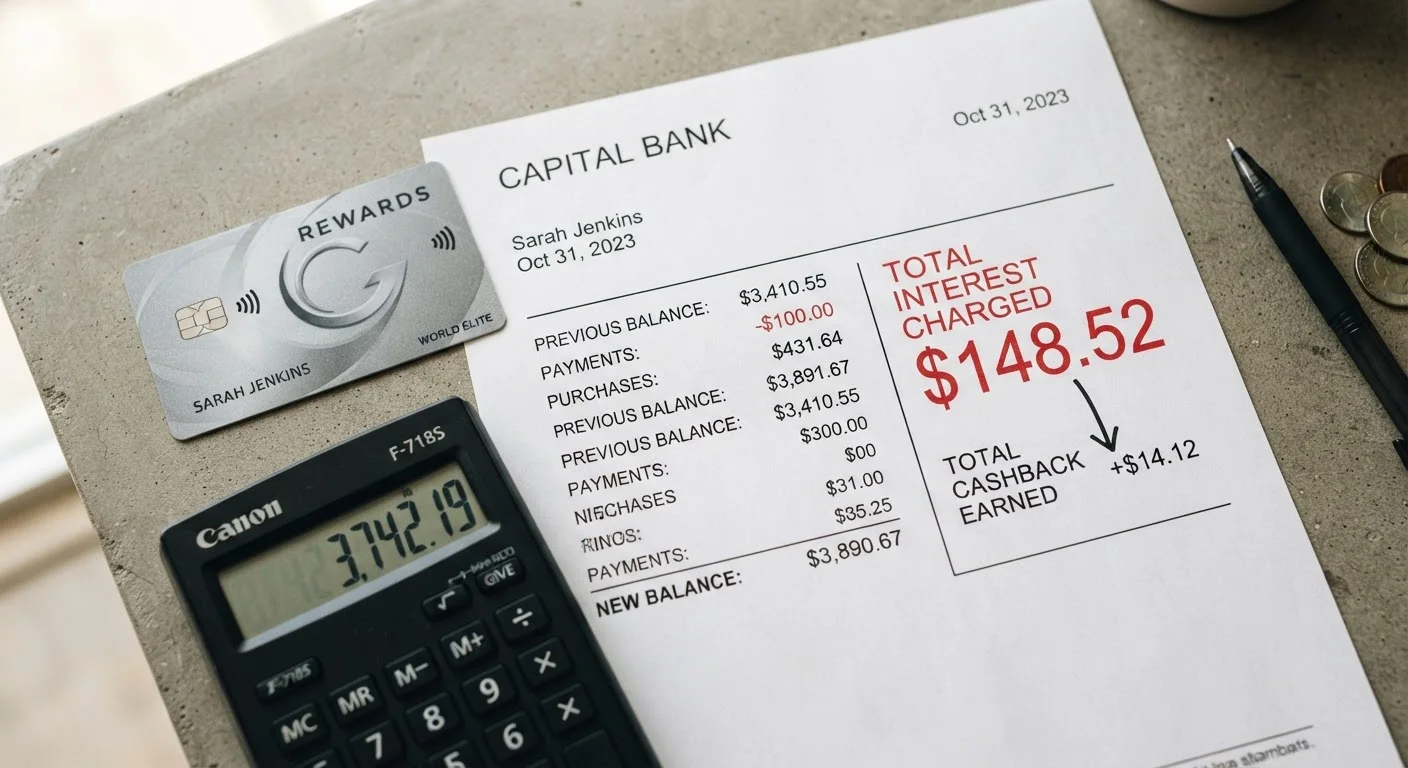
Photo: InsightsChief.com | Your Source Of Trusted Insights editorial
Key Takeaways
- Carrying a balance on a rewards card typically costs far more in interest than you earn in rewards.
- Most rewards cards carry APRs between 20% and 30%, while even top cashback rates rarely exceed 5%.
- Rewards are calculated on purchases; interest is calculated on your unpaid balance - a structurally losing trade.
- Paying your statement balance in full each month is the only reliable way to make rewards work for you.
- If you carry debt, a low-interest card will likely serve your finances better than a rewards card.
Earn value on everyday spending at no extra cost
When balances are paid in full each month, no interest accrues and every reward earned is pure gain relative to a non-rewards card charging the same fees.
Cashback effectively reduces net purchase prices
A 2% cashback rate applied to $12,000 in annual spending yields $240 - a real reduction in what you spend, provided no interest offsets it.
Automatic rewards require no behavior change
Unlike coupon clipping or tracking sales, rewards accumulate passively on purchases you would make regardless, making the benefit low-effort for full-pay cardholders.
Category bonuses can meaningfully amplify returns
Some rewards cards offer 3-5% back on groceries, gas, or dining - categories that represent significant portions of household budgets for many families.
APRs dramatically outpace any realistic reward rate
The average credit card APR in the U.S. has exceeded 20% in recent years, while even the most generous flat-rate cashback cards cap out around 2%. There is no reward structure that neutralizes this gap.
Interest charges begin immediately on carried balances
Once a balance carries past the payment due date, interest starts accruing on the full unpaid amount - often at a rate that eclipses a full month's reward earnings within days.
Rewards can create a false sense of financial benefit
Seeing rewards accumulate may mask the actual cost of carrying debt, leading some cardholders to underestimate what they owe in real terms after interest is factored in.
Annual fees can eliminate rewards gains entirely
Cards with strong reward rates often carry annual fees of $95 or more. For cardholders also paying interest, those fees tip the balance further against the cardholder.
Penalty APRs can make the math even worse
Many cards include penalty APR provisions - rates above 29% - triggered by a late payment, which can dramatically accelerate interest accrual on any carried balance.
Why the Math Almost Always Favors the Issuer
A rewards card offering 2% cashback sounds like a straightforward win. Spend $1,000, earn $20. But carry even a modest balance at a 24% annual percentage rate (APR), and that same $1,000 generates roughly $20 in interest every month it goes unpaid - wiping out your entire reward in the first billing cycle and costing more every cycle after that.
Credit card interest and credit card rewards are calculated on entirely different bases. Rewards are based on purchases made. Interest is based on the unpaid balance you carry. These are not offsetting forces - they compound in opposite directions simultaneously, and interest compounds at a rate that rewards programs cannot match.
For a fuller picture of how reward structures are designed, see how cashback, points, and miles differ - and note that no reward currency changes the underlying interest math.
20%+
Average U.S. credit card APR in recent years
Federal Reserve consumer credit data has shown average credit card interest rates exceeding 20% annually - a multi-decade high.
1-2%
Typical flat-rate cashback reward on most cards
Most standard cashback cards return between 1% and 2% on general purchases, a fraction of typical interest rates on carried balances.
The Pros: When a Rewards Card Genuinely Pays Off
To be fair, rewards cards are not inherently problematic financial tools. Under the right conditions, they offer real, measurable benefits.
Earn value on everyday spending at no extra cost
When balances are paid in full each month, no interest accrues and every reward earned is pure gain relative to a non-rewards card charging the same fees.
Cashback effectively reduces net purchase prices
A 2% cashback rate applied to $12,000 in annual spending yields $240 - a real reduction in what you spend, provided no interest offsets it.
Automatic rewards require no behavior change
Unlike coupon clipping or tracking sales, rewards accumulate passively on purchases you would make regardless, making the benefit low-effort for full-pay cardholders.
Category bonuses can meaningfully amplify returns
Some rewards cards offer 3-5% back on groceries, gas, or dining - categories that represent significant portions of household budgets for many families.
For more on structuring your card use to maximize return, compare flat-rate and category cashback cards to see which earning structure suits your spending patterns.
The Cons: How Carrying a Balance Erodes Every Reward
The disadvantages are structural, not incidental. They apply to any cardholder who does not pay the full statement balance before the due date - regardless of which card they hold or how strong the rewards program appears.
APRs dramatically outpace any realistic reward rate
The average credit card APR in the U.S. has exceeded 20% in recent years, while even the most generous flat-rate cashback cards cap out around 2%. There is no reward structure that neutralizes this gap.
Interest charges begin immediately on carried balances
Once a balance carries past the payment due date, interest starts accruing on the full unpaid amount - often at a rate that eclipses a full month's reward earnings within days.
Rewards can create a false sense of financial benefit
Seeing rewards accumulate may mask the actual cost of carrying debt, leading some cardholders to underestimate what they owe in real terms after interest is factored in.
Annual fees can eliminate rewards gains entirely
Cards with strong reward rates often carry annual fees of $95 or more. For cardholders also paying interest, those fees tip the balance further against the cardholder.
Penalty APRs can make the math even worse
Many cards include penalty APR provisions - rates above 29% - triggered by a late payment, which can dramatically accelerate interest accrual on any carried balance.
Many of the myths that lead consumers to overvalue rewards are examined directly in common reward program myths that can cost you.
Understanding the Compounding Problem
Interest on credit card balances is typically calculated using a daily periodic rate - your APR divided by 365 - applied to your average daily balance. This means interest accrues every single day you carry an unpaid balance, not just at month-end.
A cardholder carrying $2,000 at 22% APR pays approximately $36 in interest in a single month. If they also earned 1.5% cashback on $1,500 in spending that month, they earned $22.50 in rewards. The net result: a loss of roughly $13.50 - before accounting for any fees.
Grace Periods Only Protect Full Payers
To understand how minimum payments extend this problem over months or years, see how minimum payments multiply interest charges for a detailed breakdown of the repayment math.
What to Do If You're Already Carrying a Balance
If you currently carry a balance on a rewards card, the most financially sound step is to prioritize eliminating that debt before optimizing for rewards. General options worth researching include shifting the balance to a card with a lower ongoing APR, or exploring whether a promotional balance transfer offer could reduce interest costs during a defined payoff period - though balance transfer offers carry their own tradeoffs worth understanding before acting.
Once debt is cleared, a rewards card can be reintegrated as a payment tool - used only for planned spending and paid in full each month. That discipline, not the rewards rate itself, is what determines whether the card works for you or against you.
This article is for general informational and educational purposes only. It does not constitute personalized financial, tax, or legal advice. Readers should consult a qualified financial professional for guidance specific to their individual circumstances.
The content provided on our blog site traverses numerous categories, offering readers valuable and practical information. Readers can use the editorial team’s research and data to gain more insights into their topics of interest. However, they are requested not to treat the articles as conclusive. The website team cannot be held responsible for differences in data or inaccuracies found across other platforms. Please also note that the site might also miss out on various schemes and offers available that the readers may find more beneficial than the ones we cover.