
Resistance Bands vs. Free Weights for Home Training

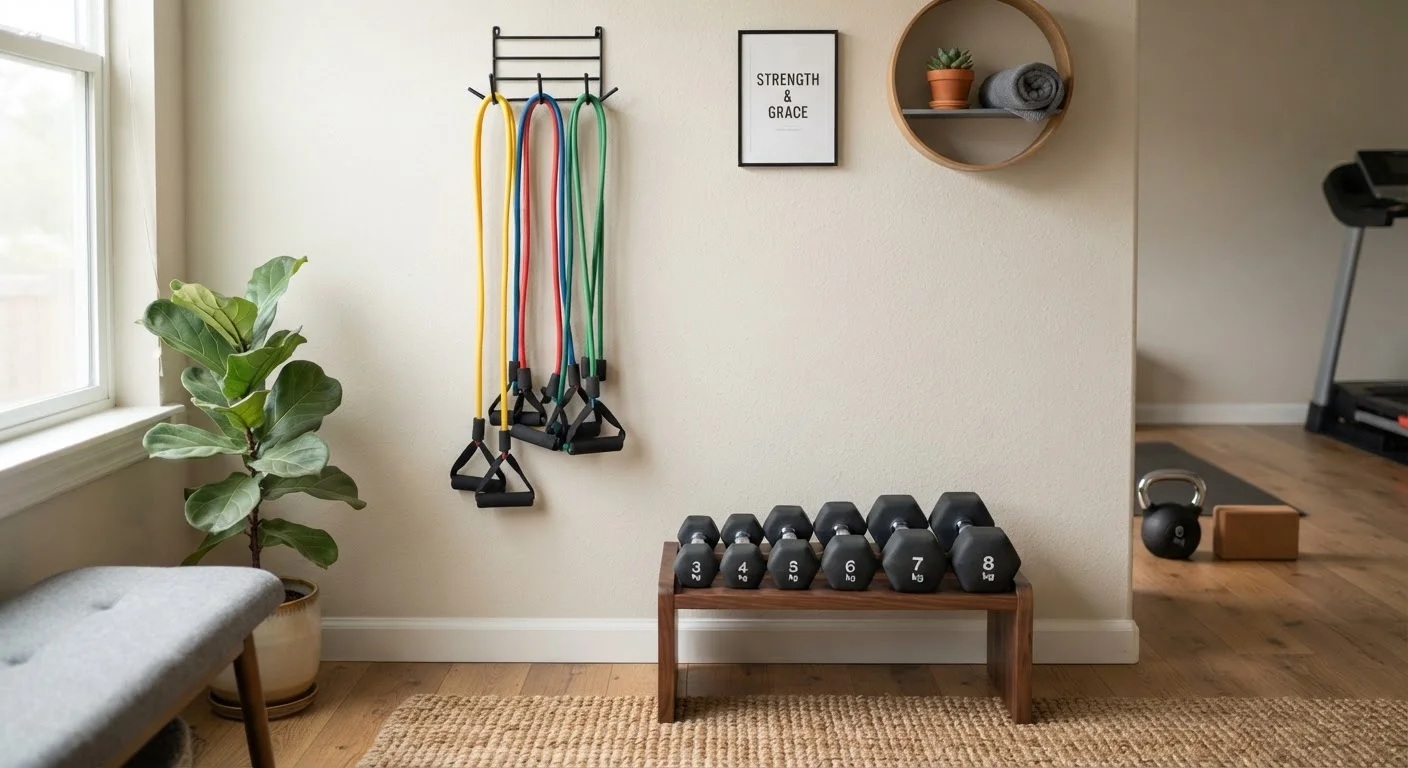
Photo: InsightsChief.com | Your Source Of Trusted Insights editorial
Key Takeaways
- Resistance bands are compact, affordable, and gentler on joints, making them accessible for most fitness levels.
- Free weights offer more predictable load progression and are well-supported by decades of strength research.
- Both tools can build meaningful strength and muscle when used consistently with proper form.
- Space, budget, and fitness goals are the three most important factors when choosing between the two.
- Many households benefit from combining both tools rather than committing exclusively to one.
How Each Tool Creates Resistance
Understanding how resistance bands and free weights work mechanically helps you predict which will serve your training goals more effectively.
Resistance bands are elastic - the tension they produce increases as the band stretches. This means resistance is lowest at the start of a movement and highest at full extension. That profile can actually align well with how muscles generate force during certain exercises, but it also means the load isn't constant throughout a repetition.
Free weights - dumbbells, barbells, and kettlebells - rely on gravity. They deliver a consistent load throughout the range of motion, which is why they are the reference standard in most strength research. The load you lift is fixed and measurable, and that predictability is a meaningful advantage when following a structured program.
For households exploring different training approaches, bodyweight training offers a third option that requires no equipment at all - useful context for understanding where bands and weights fit on the accessibility spectrum.
| Criterion | Resistance Bands | Free Weights |
|---|---|---|
| Cost | Generally low upfront cost | Moderate to high upfront cost |
| Storage space needed | Minimal - fits in a bag | Dedicated floor or rack space |
| Resistance type | Accommodating (increases with stretch) | Constant (gravity-based) |
| Load precision | Approximate | Exact and measurable |
| Progressive overload | Possible but less precise | Straightforward and well-documented |
| Joint impact | Generally lower stress on joints | Moderate; technique-dependent |
| Portability | Highly portable | Not portable |
| Exercise variety | Wide, including rotational moves | Wide, especially compound lifts |
| Beginner accessibility | High | Moderate (technique learning curve) |
Practical Considerations: Space, Cost, and Safety
For budget-conscious families, the practical factors often matter as much as the training science.
Cost: A set of resistance bands covering light to heavy resistance typically costs significantly less than an equivalent range of dumbbells. Adjustable dumbbells reduce the cost gap but remain a larger upfront investment. Neither tool requires ongoing fees.
Space: Bands fold flat and store in a bag or drawer. A dumbbell set - even a compact one - requires dedicated floor space and a storage solution. If your household is working with a small footprint, the room-by-room small-space fitness reference illustrates how both tools can be integrated into tight living arrangements.
Safety: Free weights carry a greater injury risk if dropped or used with poor form, particularly for children or beginners sharing a home space. Bands carry their own risks - a snapped or overstretched band can cause injury - so checking bands regularly for wear and following proper anchoring practices is essential. Neither tool is inherently dangerous when used correctly, but free weights demand greater environmental awareness.
~$20-$50
Typical cost of a resistance band set
A multi-resistance band kit generally falls in this range, compared to hundreds of dollars for an equivalent dumbbell set - a meaningful difference for households on a tight budget.
Similar
Muscle activation vs. free weights
A review published in the Journal of Human Kinetics found comparable levels of muscle activation between elastic resistance and free-weight exercises in several upper- and lower-body movements.
6 sq ft
Approximate floor space for a band workout
Most band-based routines require only a standing or lying body-length area, making them practical for apartments, bedrooms, or small living rooms.
Which Builds More Strength - and Does It Matter?
Research comparing resistance bands and free weights generally finds that both can stimulate meaningful muscle and strength development, particularly in untrained or recreationally active individuals. The difference in outcomes appears less significant than the difference in consistency - the tool you use regularly will outperform the one gathering dust.
That said, free weights have a documented edge in progressive overload (gradually increasing training load over time), the principle most consistently linked to strength gains. With bands, progression is less precise: resistance changes with band thickness, stretch distance, and anchor point, making it harder to quantify small load increases. For people pursuing structured strength goals, that imprecision can become a limitation.
Bands tend to excel in unilateral movements (working one limb at a time), rotational exercises, and mobility-focused work - areas where free weights are less intuitive. Many fitness practitioners use both tools in tandem rather than choosing one exclusively.
For a balanced view of what consistent home training actually involves day-to-day, the honest trade-offs of daily home workouts is worth reading alongside this comparison.
This article is for general informational and educational purposes only and is not a substitute for professional medical or fitness advice. Consult a qualified healthcare or exercise professional before beginning any new training program, particularly if you have an existing health condition or injury.
The content provided on our blog site traverses numerous categories, offering readers valuable and practical information. Readers can use the editorial team’s research and data to gain more insights into their topics of interest. However, they are requested not to treat the articles as conclusive. The website team cannot be held responsible for differences in data or inaccuracies found across other platforms. Please also note that the site might also miss out on various schemes and offers available that the readers may find more beneficial than the ones we cover.