
Tire Pressure, Tread Depth, and Rotation: A Driver's Reference Card

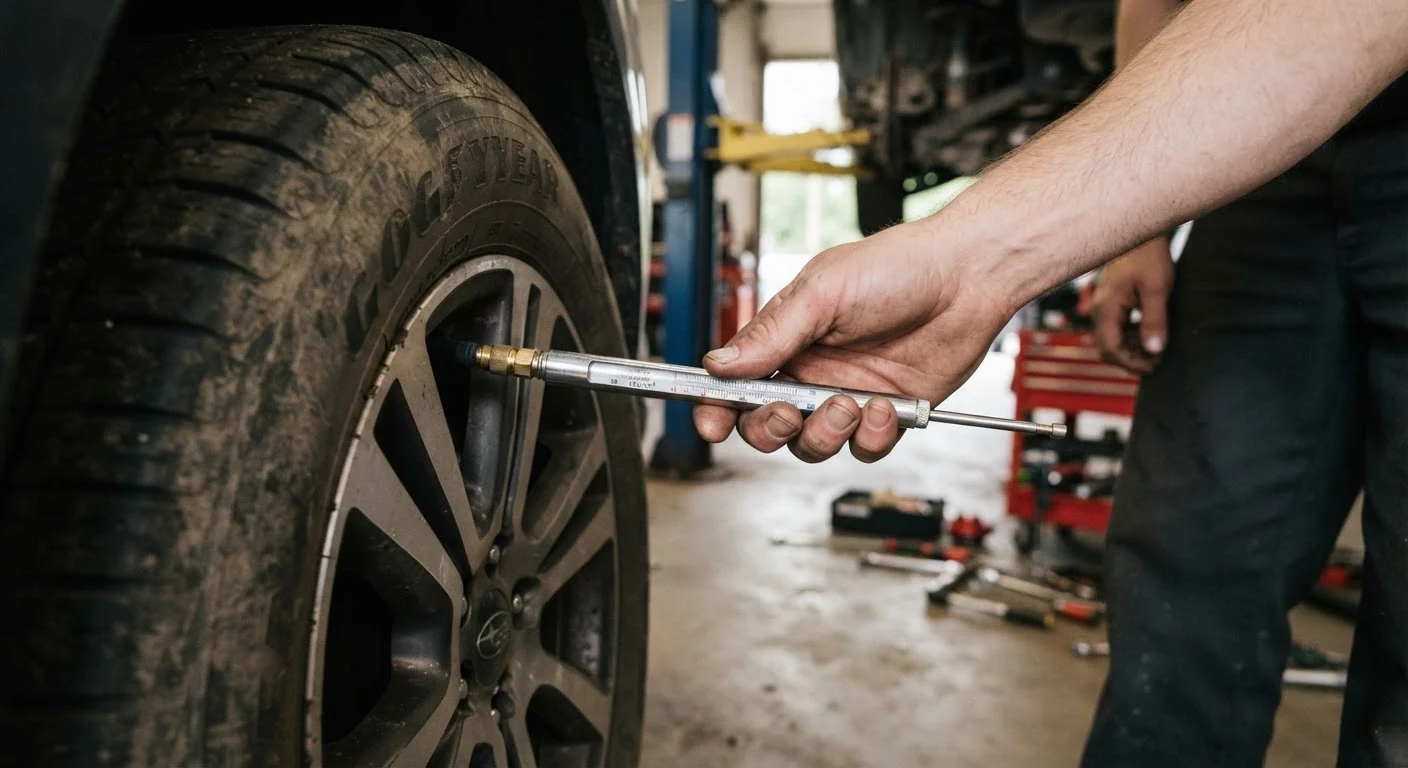
Photo: InsightsChief.com | Your Source Of Trusted Insights editorial
Tire Pressure: The Numbers You Need
The correct inflation pressure for your tires is set by the vehicle manufacturer - not by the tire maker. Look for a sticker on the driver's door jamb or inside the fuel-filler door. That label shows the recommended cold inflation pressure in PSI for both front and rear tires, and often for a loaded or towing condition as well.
| Where to find correct tire pressure | Driver's door jamb sticker or owner's manual |
| Typical passenger tire PSI range | 30-35 PSI (varies by vehicle) |
| Temperature effect on pressure | ~1 PSI drop per 10°F temperature decrease |
| Recommended check frequency | Monthly and before long trips |
| Legal minimum tread depth (US) | 2/32 inch (Federal Motor Vehicle Safety Standards) |
| Recommended replacement threshold | 4/32 inch (wet-weather safety margin) |
Check pressure when the tires are cold - meaning the vehicle has been parked for at least three hours or driven fewer than one mile. Driving heats the air inside tires, temporarily raising pressure by 4-8 PSI. Reading a hot tire and bleeding it down to the recommended figure will leave you underinflated once it cools.
Tire pressure drops roughly 1 PSI for every 10°F fall in ambient temperature. That means a tire that was properly inflated in September may be noticeably low by December without any air loss at all. Make a habit of checking monthly and before any long road trip. If your dashboard TPMS light illuminates, don't ignore it - see what TPMS and other warning lights actually mean before dismissing it as a false alarm.
Tread Depth: Reading the Wear
New passenger tires typically ship with 10/32" to 11/32" of tread depth. Federal law sets a minimum safe limit of 2/32", at which point tires must be replaced. Many safety organizations recommend replacing tires at 4/32", particularly in wet-weather regions, because stopping distances increase significantly before the legal limit is reached.
Cold inflation pressure
Tire pressure measured when tires have not been driven for at least three hours. This is the standard used for all manufacturer PSI recommendations, since driving heat temporarily increases pressure.
TPMS
Tire Pressure Monitoring System - a federal requirement on all vehicles sold in the US after 2007. A dashboard light alerts you when one or more tires is significantly underinflated, typically 25% below the recommended PSI.
Tread wear indicator
Raised bars molded into the tire's tread grooves at 2/32" depth. When the tread surface is flush with these bars, the tire has reached the legal wear limit and must be replaced.
Rotation pattern
The specific sequence in which tires are moved between axle positions during a rotation service. The correct pattern depends on the vehicle's drivetrain type and whether tires are directional or non-directional.
Directional tire
A tire designed to roll in one specific direction, indicated by an arrow on the sidewall. These tires can only be rotated front-to-rear on the same side of the vehicle without remounting.
How to check without a gauge: Insert a U.S. penny into the tread groove with Lincoln's head pointing down. If you can see the top of Lincoln's head, tread is at or below 2/32" - replace immediately. Use a quarter the same way: if Washington's head is fully visible, you're at or below 4/32" and approaching the replacement window. A dedicated tread-depth gauge (typically under $5 at auto parts stores) gives you an exact reading.
Check tread at multiple points across each tire's width. Uneven wear - worn edges with good center tread, or a worn center with good edges - points to chronic under- or over-inflation, or a suspension alignment issue that should be inspected by a qualified mechanic.
Rotation Intervals and Patterns
Rotating tires moves them to different positions on the vehicle so that wear is distributed evenly across all four. Front tires on front-wheel-drive vehicles typically wear faster because they handle both steering and power delivery. Without rotation, you may need to replace front tires while the rears still have plenty of life - an avoidable extra cost.
General interval guidance: Most manufacturers recommend rotating tires every 5,000-7,500 miles. A common, convenient practice is to rotate with every other oil change. Always follow your owner's manual, which specifies the interval and any pattern requirements for your drivetrain. For more on reading manufacturer schedules, see your car's maintenance schedule, explained.
Spare Tires Have Their Own Pressure Requirement
Common rotation patterns:
- Forward cross - rear tires move straight forward; fronts cross to the opposite rear. Typical for front-wheel-drive vehicles.
- Rearward cross - front tires move straight back; rears cross to the opposite front. Typical for rear- and all-wheel-drive vehicles.
- X-pattern - all four tires cross to the opposite axle and side. Used when wear is particularly uneven.
Directional tires (those with a one-way tread pattern marked by an arrow on the sidewall) can only be moved front-to-rear on the same side. If you also need to switch sides, the tires must be dismounted and remounted - a shop task. Staggered fitments, where rear tires are wider than fronts, may not allow rotation at all without swapping tires on rims.
Tire maintenance is one of the more controllable line items in total vehicle ownership costs. Keeping tires properly inflated and rotated on schedule can extend their usable life by tens of thousands of miles.
The content provided on our blog site traverses numerous categories, offering readers valuable and practical information. Readers can use the editorial team’s research and data to gain more insights into their topics of interest. However, they are requested not to treat the articles as conclusive. The website team cannot be held responsible for differences in data or inaccuracies found across other platforms. Please also note that the site might also miss out on various schemes and offers available that the readers may find more beneficial than the ones we cover.