
Liability, Collision, and Comprehensive: What Each Coverage Actually Covers

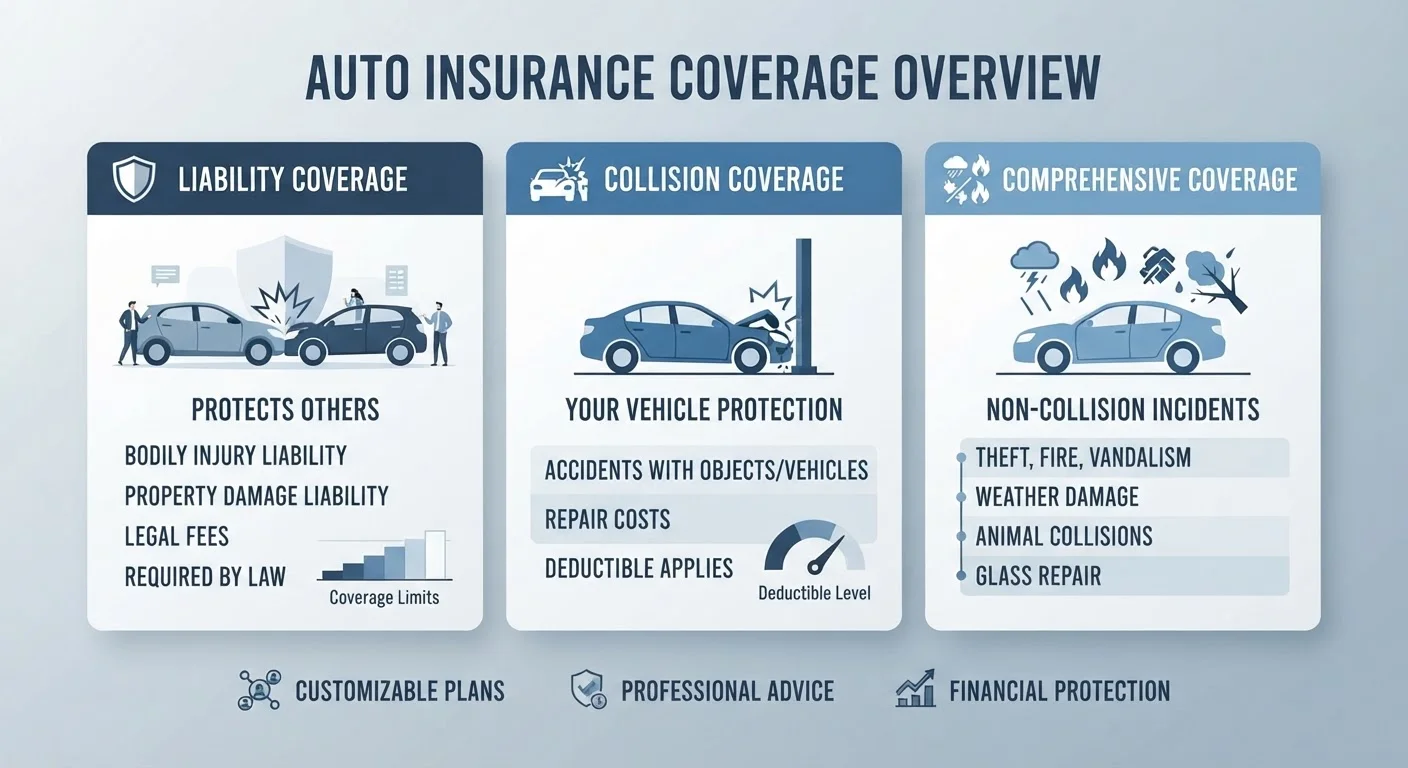
Photo: InsightsChief.com | Your Source Of Trusted Insights editorial
The Three Core Coverages at a Glance
Most standard auto insurance policies are built from three foundational coverage types: liability, collision, and comprehensive. Each one pays for a different category of loss, and none of them overlap completely. Knowing which coverage applies in which situation helps you avoid surprises when a claim actually happens.
For a broader overview of how auto insurance is structured, see Car Insurance Decoded.
Liability Coverage: Protecting Others When You're at Fault
Liability coverage pays for bodily injury and property damage that you cause to other people in an accident where you are found at fault. It does not pay for your own injuries or damage to your own vehicle.
Liability is broken into two sub-types:
- Bodily injury liability (BI): Covers medical expenses, lost wages, and legal costs for other people injured in a crash you caused. Limits are typically expressed as two numbers - for example, $50,000 per person / $100,000 per accident.
- Property damage liability (PD): Pays to repair or replace another person's vehicle or property (a fence, a storefront) that you damaged. Expressed as a single per-accident limit.
Every state that requires car insurance requires some minimum level of liability coverage, though those minimums vary considerably. Minimum limits are often too low to fully cover a serious accident, which can leave you personally responsible for the difference. Carrying higher limits - or an umbrella policy - is generally worth considering if you have assets to protect.
State Minimums Are a Floor, Not a Target
Liability does not cover hit-and-run scenarios where the other driver cannot be identified, or accidents caused by an uninsured driver. For those situations, see uninsured and underinsured motorist coverage.
Collision and Comprehensive: Protecting Your Own Vehicle
Unlike liability, collision and comprehensive both pay for damage to your own car. They cover different causes of damage, which is why they are almost always sold together.
Collision Coverage
Collision pays to repair or replace your vehicle after it is damaged in a crash - whether you hit another car, a guardrail, or a telephone pole. It applies regardless of fault. If you are hit by another driver who is at fault, their liability coverage should pay; if they are uninsured or the claim is disputed, your collision coverage serves as a practical backstop.
Both collision and comprehensive carry a deductible - the amount you pay out of pocket before your insurer covers the rest. Common deductible amounts range from $250 to $1,500. A higher deductible lowers your premium but increases your out-of-pocket exposure after a claim.
Comprehensive Coverage
Comprehensive (sometimes called "other than collision") covers damage caused by events that are largely outside your control: theft, vandalism, fire, flooding, hail, falling objects, and collisions with animals such as deer. If a tree branch falls on your parked car overnight, that is a comprehensive claim - not collision.
Deciding when to file which type of claim is not always obvious. Collision vs. Comprehensive: Knowing Which Claim to File walks through specific scenarios in detail.
Liability Coverage
The portion of an auto policy that pays for bodily injury or property damage you cause to others in an at-fault accident. It does not cover your own vehicle or injuries.
Collision Coverage
Coverage that pays to repair or replace your vehicle after a crash with another vehicle or object, regardless of who was at fault.
Comprehensive Coverage
Coverage for damage to your vehicle caused by events other than a collision - including theft, fire, flooding, hail, and animal strikes.
Deductible
The amount you agree to pay out of pocket before your insurance company covers the remaining cost of a claim. Applies to both collision and comprehensive coverage.
Actual Cash Value (ACV)
The market value of your vehicle at the time of a loss, accounting for depreciation. This is typically what insurers pay on a total-loss claim, not the original purchase price.
Split Limits
A way of expressing liability coverage as separate per-person and per-accident amounts for bodily injury, plus a separate amount for property damage (e.g., 50/100/50).
Common Coverage Gaps to Watch For
Even with all three coverage types in place, there are situations where none of them pay:
- Mechanical breakdown: Engine failure or worn-out components are not covered by any of these three coverages. That falls to a vehicle service contract or manufacturer warranty.
- Personal belongings stolen from your car: Comprehensive covers the vehicle itself, not a laptop left on the seat. Homeowners or renters insurance typically covers personal property theft.
- Gap between your loan balance and your car's actual cash value: If your car is totaled, collision and comprehensive pay the vehicle's current market value - which may be less than what you still owe on your loan. Gap insurance is designed specifically to cover this difference.
- Dropping collision or comprehensive prematurely: Paying off a loan is not always the right trigger to remove these coverages. Common car insurance decisions that often backfire explains when this move can cost more than it saves.
This article provides general information about auto insurance coverage types. It is not personalized insurance, financial, or legal advice. Coverage terms, exclusions, limits, and requirements vary by state and by insurer. Always read your policy documents carefully and consult a licensed insurance professional for guidance specific to your situation.
The content provided on our blog site traverses numerous categories, offering readers valuable and practical information. Readers can use the editorial team’s research and data to gain more insights into their topics of interest. However, they are requested not to treat the articles as conclusive. The website team cannot be held responsible for differences in data or inaccuracies found across other platforms. Please also note that the site might also miss out on various schemes and offers available that the readers may find more beneficial than the ones we cover.