
Full Coverage vs. Minimum Coverage: Weighing the Trade-Offs

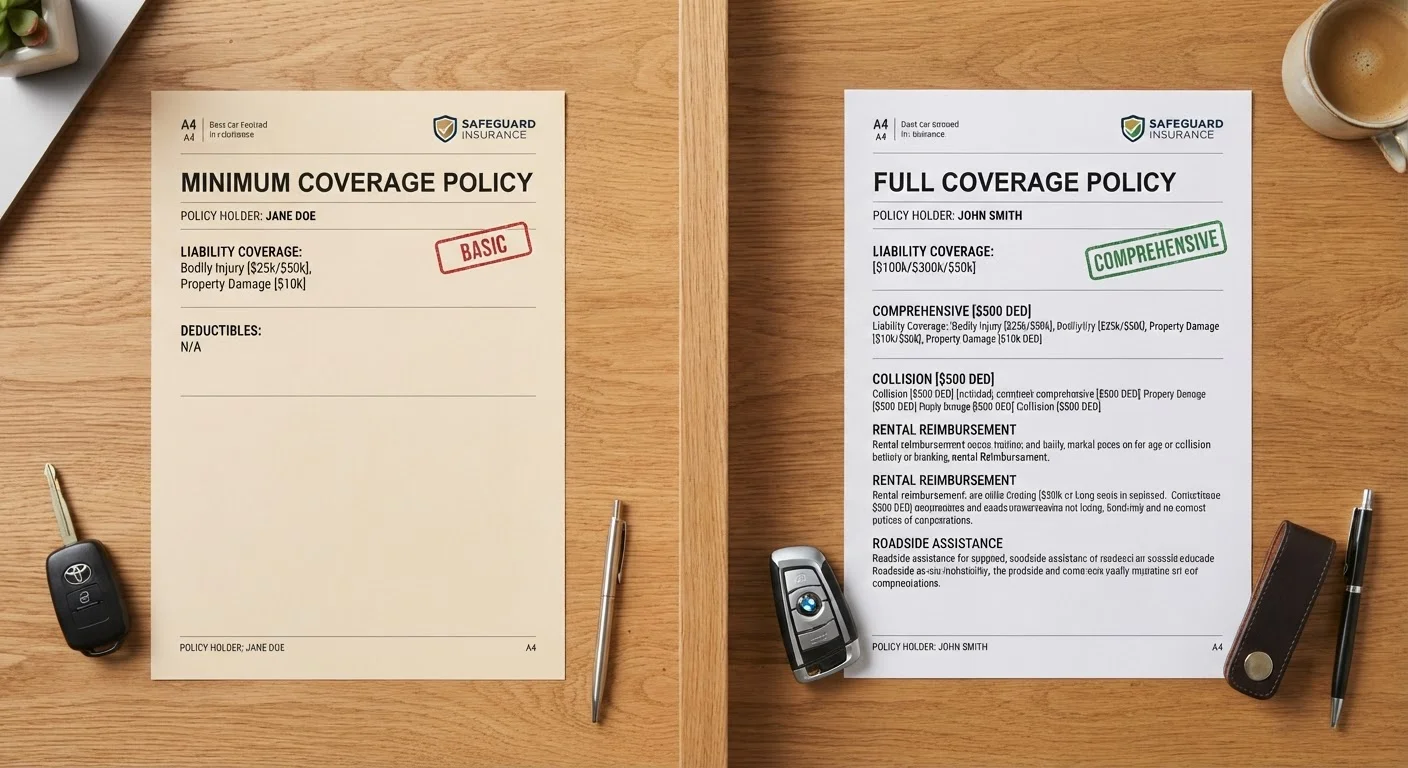
Photo: InsightsChief.com | Your Source Of Trusted Insights editorial
Key Takeaways
- Minimum coverage only meets state legal requirements and does not pay for damage to your own vehicle.
- Full coverage adds collision and comprehensive protection, covering your car in most accident and non-accident scenarios.
- Your vehicle's age, value, and any loan or lease obligation are the most important factors in this decision.
- A general rule of thumb: if annual premiums for full coverage exceed 10% of the car's market value, minimum coverage may be worth reconsidering.
- Dropping comprehensive and collision does not mean you are uninsured - liability still protects others you may harm.
- Neither coverage level guarantees full financial protection; gaps like medical costs or uninsured drivers may still exist.
What Each Coverage Level Actually Includes
The term minimum coverage refers to the legally mandated floor set by each state - typically bodily injury liability and property damage liability. Liability coverage pays for injuries and property damage you cause to others in an at-fault accident. It does not pay for damage to your own vehicle or your own medical bills. Requirements vary significantly by state, so what qualifies as minimum in one state may be inadequate in another.
Full coverage is not a single product with a fixed definition. In common usage, it refers to a policy that combines liability with both collision and comprehensive coverage. Collision pays for damage to your vehicle from an accident, regardless of fault. Comprehensive covers non-collision events such as theft, weather damage, fire, and animal strikes. For a detailed breakdown of how each component works, see what liability, collision, and comprehensive each cover.
| Criterion | Minimum Coverage | Full Coverage |
|---|---|---|
| Legally required | Yes - meets state minimums | No - exceeds requirements |
| Covers damage to others | Yes (liability only) | Yes (liability included) |
| Covers your vehicle in an accident | No | Yes (collision coverage) |
| Covers theft, weather, animals | No | Yes (comprehensive coverage) |
| Required for financed/leased vehicles | No - typically insufficient | Yes - typically required |
| Monthly premium | Lower | Higher |
| Out-of-pocket risk if your car is damaged | High | Limited to deductible |
The Real Cost Comparison
Minimum coverage premiums are lower by definition - you are buying less protection. The trade-off is financial exposure. If you cause an accident and your liability limits are too low to cover the damages, you are personally responsible for the remainder. If someone hits your car and they are uninsured or underinsured, minimum coverage leaves your vehicle repairs entirely to you. That risk is more common than many drivers realize - one in eight US drivers carries no insurance at all.
Full coverage costs more monthly, but it limits worst-case financial outcomes. The practical question is whether the added premium is proportionate to the value you are protecting. A frequently cited rule of thumb in insurance guidance: if your combined annual collision and comprehensive premium exceeds roughly 10% of your vehicle's current market value, the math may favor dropping those coverages. This is a rough heuristic, not a guarantee - your specific deductible, driving history, and financial situation all matter.
1 in 8
US drivers estimated to be uninsured
According to the Insurance Research Council, roughly 12-13% of motorists on US roads carry no auto insurance, increasing risk for drivers with minimum-only coverage.
~40%
Average premium difference: minimum vs. full coverage
Industry estimates generally show full coverage costs 30-50% more than minimum coverage annually, though the gap varies widely by state, vehicle, and driver profile.
Key Factors That Should Drive Your Decision
Vehicle value is the starting point. Look up your car's current market value through sources like Kelley Blue Book or NADA Guides before deciding. A vehicle worth $4,000 produces very different coverage math than one worth $22,000.
Loan or lease status is often non-negotiable. Most lenders and lessors require comprehensive and collision coverage as a condition of financing. Carrying only minimum coverage on a vehicle you do not yet own outright may violate your contract and trigger forced-placed insurance - typically at a far higher cost.
Your financial reserves matter as much as the premium. If an unexpected $8,000 repair bill would cause genuine financial hardship, the monthly cost of full coverage is effectively a hedge against that risk. If you have the liquidity to self-insure a total loss, the calculation shifts.
Driving environment and habits also play a role. High-mileage commuters, drivers in dense urban areas, and those in regions prone to hail, flooding, or vehicle theft face statistically higher exposure than low-mileage rural drivers. Some of the most costly coverage decisions involve dropping full coverage after a loan payoff without reassessing these factors first.
When shopping policies, comparing quotes across multiple scenarios is essential - but raw premium numbers only tell part of the story. Understanding what the numbers are actually telling you helps you avoid choosing a lower premium that leaves significant gaps in protection.
Minimum Coverage Limits Vary by State
The content provided on our blog site traverses numerous categories, offering readers valuable and practical information. Readers can use the editorial team’s research and data to gain more insights into their topics of interest. However, they are requested not to treat the articles as conclusive. The website team cannot be held responsible for differences in data or inaccuracies found across other platforms. Please also note that the site might also miss out on various schemes and offers available that the readers may find more beneficial than the ones we cover.