
Comparing Auto Insurance Quotes: What the Numbers Are Really Telling You

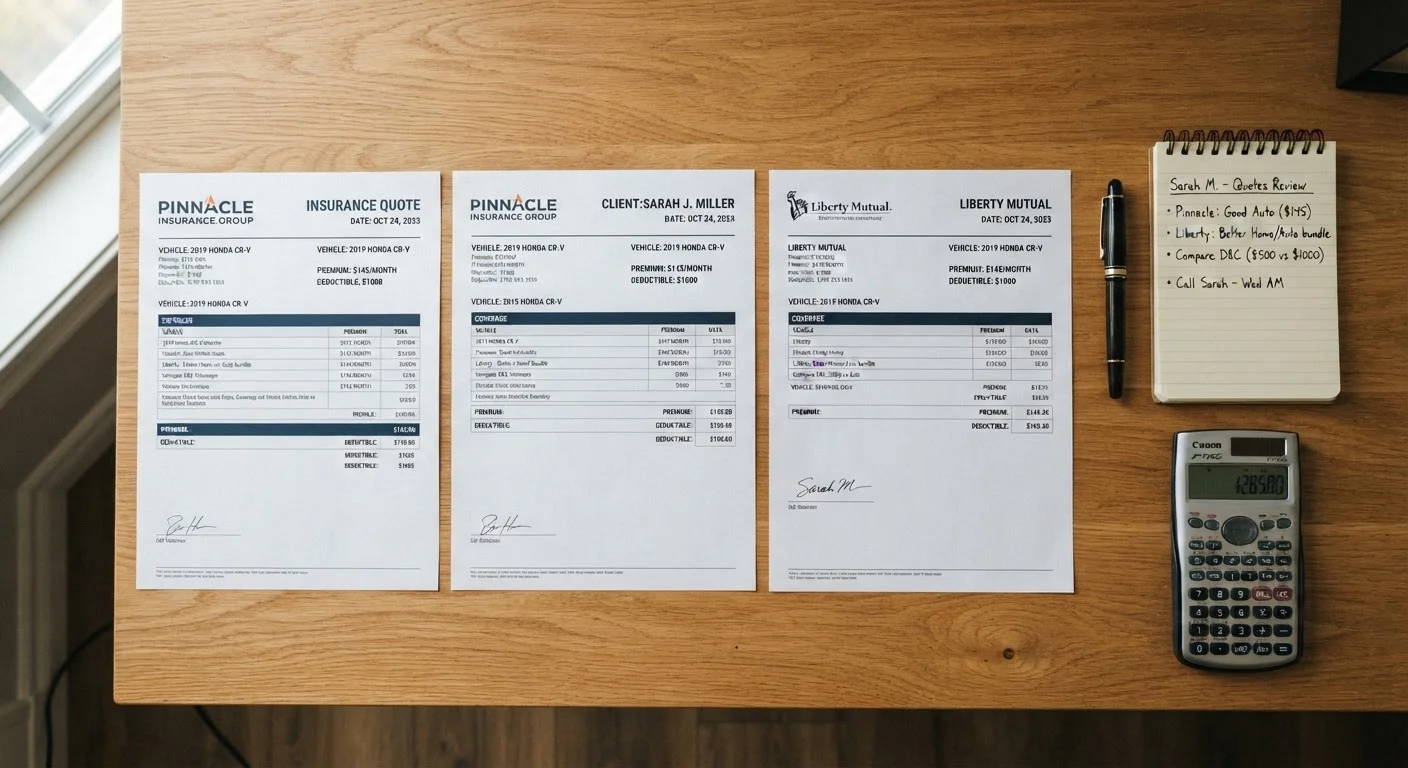
Photo: InsightsChief.com | Your Source Of Trusted Insights editorial
Key Takeaways
- The lowest premium quote often reflects lower coverage limits or higher deductibles, not a better deal.
- Comparing quotes on equal terms requires matching coverage types, limits, and deductibles across every quote.
- Insurer financial strength and claims reputation matter as much as price when choosing a policy.
- Deductible choices directly affect both your premium and your out-of-pocket exposure after a claim.
- Discount eligibility varies by insurer - the same driver can qualify for more savings at one carrier than another.
Why Quote Comparisons Go Wrong
Most drivers approach auto insurance shopping the same way they approach buying gas - looking for the lowest number. That instinct is understandable, but it leads to a predictable mistake: comparing premiums without comparing what those premiums actually buy.
A quote is a price estimate tied to a specific set of coverage choices. Change the deductible, adjust the liability limits, or drop an optional coverage, and the price changes - sometimes dramatically. When insurers generate quotes, they don't always default to identical assumptions. One might quote you a $500 deductible; another might default to $1,000. One might include uninsured motorist coverage; another might leave it out. The result is that you're often comparing apples to oranges without realizing it.
Before you can make a meaningful comparison, you need to understand what each number represents. Our plain-language guide to coverage types is a useful starting point if any of the standard terms - liability, comprehensive, collision, UM/UIM - are still unclear.
Build a Consistent Comparison Standard
What You Need Before You Start
Gathering the right information before requesting quotes saves time and improves accuracy. Insurers use a consistent set of inputs to generate rates, and gaps in that information can produce quotes that don't reflect your actual situation.
What you will need
Once you have this information ready, you can request quotes from multiple insurers using the same inputs. Consistency is the entire point - if you give different answers to different insurers, you're back to comparing unlike things.
How to Compare Quotes Step by Step
The process below walks you through a structured comparison. Following it won't guarantee you find the right policy - coverage decisions depend on your individual circumstances - but it will help you read the numbers accurately so you can make an informed choice.
Set your coverage baseline first
Decide on the coverage types and minimum limits you want before you contact any insurer. At minimum, consider: your state's required liability minimums (and whether you want higher limits), whether to include collision and comprehensive, and whether to add uninsured/underinsured motorist coverage. Write these down as your standard. Every quote you request should be built on this same standard.
Request quotes using identical inputs
Contact each insurer - or use their online quoting tools - and enter the same coverage types, limits, and deductibles you defined in Step 1. Do not let the system default to different values without adjusting them to match your baseline. Note the exact inputs used for each quote so you can verify consistency later.
Line up the quotes in a comparison table
Create a simple table - spreadsheet or paper - with one row per insurer and columns for: annual premium, liability limits (bodily injury per person / per occurrence / property damage), collision deductible, comprehensive deductible, UM/UIM limits, and any optional coverages included. This format makes it immediately visible when one quote is cheaper because it offers less, not because the insurer is more efficient.
Check what each quote excludes
Premium comparisons focus on what's included, but exclusions matter just as much. Review the summary of each quote for common exclusions: rideshare use, business use of the vehicle, coverage gaps for drivers in your household who aren't listed, or limitations on rental reimbursement. An insurer that excludes a scenario relevant to your life is not equivalent to one that covers it, even at the same price.
Verify discounts applied to each quote
Ask each insurer to provide a breakdown of discounts applied to your quote. Common discounts include multi-policy bundling, good driving history, low annual mileage, anti-theft devices, and completing a defensive driving course. The discount structure varies significantly between carriers - confirm you've received credit for everything you qualify for before treating the premium as final.
Factor in financial strength and complaint data
Look up each insurer's AM Best financial strength rating and your state's complaint ratio data for that carrier. A policy is only as valuable as the insurer's ability and willingness to pay claims. If two quotes are close in price and coverage terms, these factors can be a reasonable tiebreaker.
This article provides general insurance education and is not personalized advice. Coverage terms, limits, exclusions, and premiums vary by insurer and by state. Always read the actual policy documents and consult a licensed insurance agent or adviser for guidance specific to your situation.
Reading the Numbers More Deeply
Once you've aligned quotes on the same coverage terms, a few additional factors separate a policy that looks good on paper from one that holds up after a claim.
Financial strength ratings
An insurer's ability to pay claims depends on its financial health. Independent rating organizations - such as AM Best, Moody's, and Standard & Poor's - publish financial strength ratings for insurance carriers. These are publicly available and worth checking. A carrier with a weak rating may price aggressively to attract customers while carrying more solvency risk than a higher-rated competitor.
Claims handling reputation
State insurance departments publish complaint ratio data - the number of complaints an insurer receives relative to its market share. A higher complaint ratio can be a signal of slow claims processing, disputed settlements, or poor communication. This information is typically available on your state's department of insurance website at no cost.
Deductible math
A higher deductible lowers your premium but increases your out-of-pocket cost when you file a claim. It's worth calculating the break-even point: divide the annual premium savings from a higher deductible by the additional out-of-pocket exposure. If the break-even point is five or more years away, the higher deductible may not serve you well - especially if an at-fault accident is a realistic possibility. Our overview of how insurers calculate premiums explains how deductibles factor into the broader pricing picture.
Discount alignment
The same driver can receive meaningfully different discount stacks from different carriers. One insurer might offer a strong bundling discount; another might reward low annual mileage more generously. Once your quotes are on equal footing by coverage terms, ask each insurer to confirm every discount applied. For a breakdown of credits that are commonly missed, see our article on overlooked auto insurance discounts.
For strategies on reducing costs further once you've selected a policy, legitimate ways to lower your premium covers the options most worth considering.
Don't Finalize Based on Price Alone
The content provided on our blog site traverses numerous categories, offering readers valuable and practical information. Readers can use the editorial team’s research and data to gain more insights into their topics of interest. However, they are requested not to treat the articles as conclusive. The website team cannot be held responsible for differences in data or inaccuracies found across other platforms. Please also note that the site might also miss out on various schemes and offers available that the readers may find more beneficial than the ones we cover.