
Debt Avalanche vs. Debt Snowball: Which Payoff Strategy Fits Your Situation

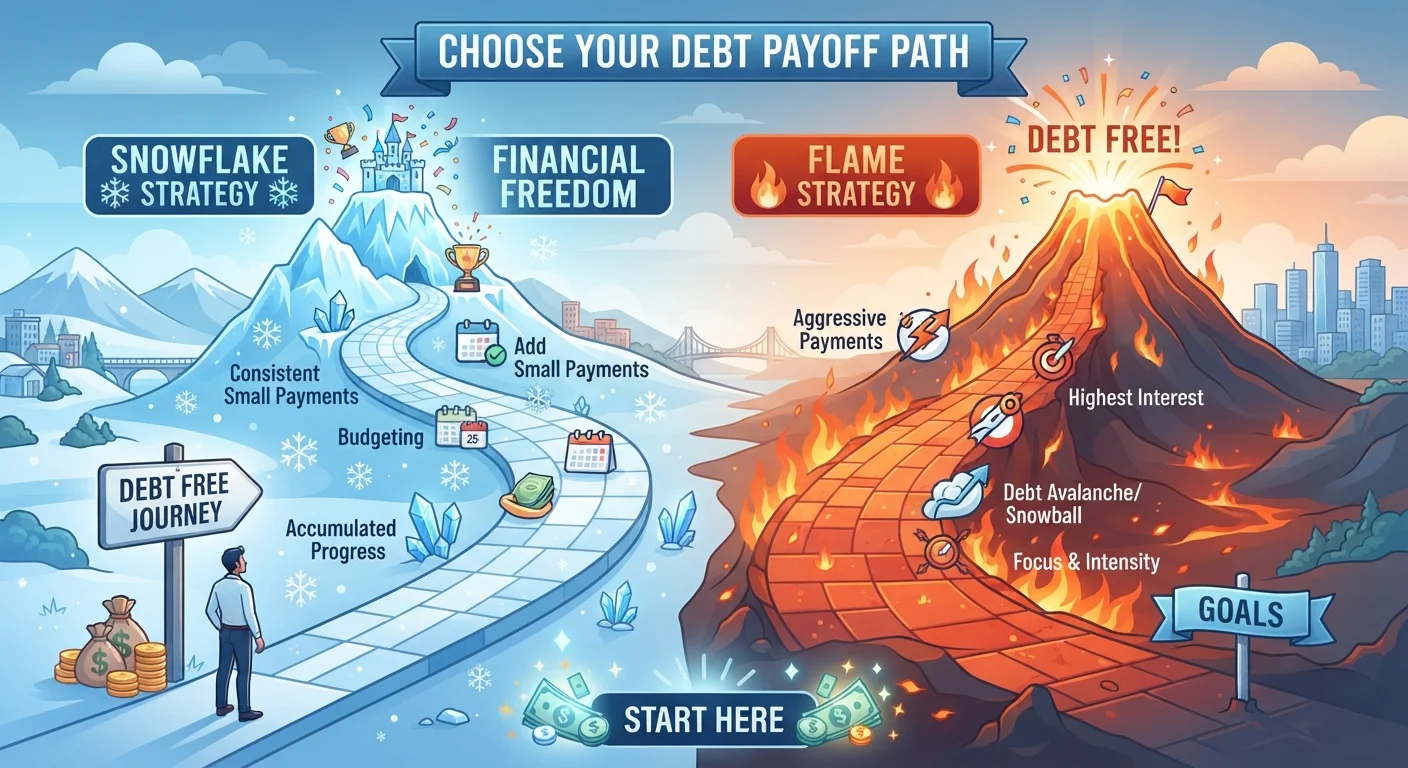
Photo: InsightsChief.com | Your Source Of Trusted Insights editorial
Key Takeaways
- The debt avalanche targets the highest interest rate first, reducing total interest paid over time.
- The debt snowball pays off the smallest balance first, building motivational momentum.
- Research suggests many people stick with the snowball longer due to psychological rewards.
- Either method requires paying minimums on all debts while directing extra money to one priority account.
- The 'best' method is the one you'll follow through to completion - math only matters if you stay the course.
- Both strategies outperform paying only minimum balances, which dramatically extends payoff timelines.
How Each Method Actually Works
Both strategies share the same mechanical foundation: pay the minimum required on every debt each month, then direct any extra dollars you can free up toward one specific target account. What differs is how you choose that target.
Debt Avalanche: Rank your debts from highest annual percentage rate (APR) to lowest. Your extra payment goes to the highest-rate balance first. Once that's eliminated, redirect all its freed-up payment to the next highest rate, and so on. Because high-rate debt accumulates interest fastest, eliminating it first slows the overall growth of what you owe.
Debt Snowball: Rank your debts from smallest total balance to largest, regardless of interest rate. Your extra payment attacks the smallest balance until it's gone, then rolls that payment into the next smallest. The name reflects how payment amounts grow as each eliminated debt adds to the total being thrown at the next one.
If terms like APR are unfamiliar, the household debt glossary provides plain-language definitions for the key numbers that appear on your statements.
| Criterion | Debt Avalanche | Debt Snowball |
|---|---|---|
| Payoff order | Highest APR first | Smallest balance first |
| Total interest paid | Lower (often significantly) | Higher (varies by rate spread) |
| Time to first paid-off debt | Potentially longer | Faster initial win |
| Psychological motivation | Requires patience; less frequent wins | Frequent milestones; strong momentum |
| Best when rates differ greatly | Yes - maximizes savings | Less advantageous |
| Best when rates are similar | Modest advantage | Behavioral benefit may outweigh cost |
| Complexity | Slightly higher (track APRs) | Simple (sort by balance) |
| Impact on number of accounts | Slower reduction in open accounts | Faster reduction in open accounts |
The Real Cost Difference: Interest Paid Over Time
The avalanche method wins on pure math - consistently. By targeting high-rate debt first, you reduce the principal on which the steepest interest is calculated, slowing the rate at which your total owed grows. Over a multi-year payoff, that gap can mean hundreds or even thousands of dollars in avoided interest charges, depending on your balances and rates.
The snowball's cost isn't zero, but it isn't always dramatic either. When debts carry similar interest rates, the difference in total interest paid between the two methods can be modest - sometimes small enough that the behavioral advantage of the snowball justifies it financially.
~$1,000+
Potential interest savings with avalanche vs. snowball
The gap varies widely by balance size and rate spread; households with high-APR debt and large balances tend to see the largest savings from avalanche ordering.
3-5 years
Typical credit card payoff timeline using a structured method
The Consumer Financial Protection Bureau notes that consistent extra payments substantially compress payoff timelines compared to minimum-only payment plans.
28%+
Penalty APR common on credit cards after missed payments
Federal Reserve data shows some credit cards carry penalty rates exceeding 28% APR, making high-rate targeting especially impactful for affected cardholders.
Where the cost difference widens significantly is when you carry one very high-rate debt alongside lower-rate obligations. If a balance at 28% APR sits untouched while you clear a 12% balance, the high-rate account is quietly compounding against you. That's the exact scenario where the avalanche earns its reputation.
It's worth understanding why minimum payments alone are so costly before choosing either strategy. Our article on why minimum payments cost far more than they appear shows how the math plays out over time.
The Behavioral Factor: Why Consistency Beats Optimization
A debt payoff strategy you abandon at month four saves you nothing. This is where the snowball gains credibility beyond its math.
Behavioral economics research has found that people are more likely to continue a goal when they experience measurable progress early on. Closing out a debt account entirely - even a small one - produces a concrete sense of accomplishment that abstract interest savings cannot replicate. The number of open accounts shrinks, monthly obligations simplify, and the psychological load of managing multiple debts lightens.
Conversely, the avalanche can feel unrewarding for months or years if your highest-rate debt also carries a large balance. You're making payments, the balance is dropping, but nothing is fully eliminated. For some households, that sustained grind leads to fatigue and inconsistency.
Neither outcome is guaranteed for any individual. Self-knowledge matters here: honestly assess whether you've historically stayed engaged with financial goals over the long haul, or whether you've needed visible milestones to stay on track. Both are valid - the question is which approach aligns with how you actually behave, not how you'd ideally like to behave.
For a broader framework on managing debt from start to finish, the end-to-end debt management roadmap walks through prioritization, credit protection, and what financial freedom looks like on the other side.
Combining Approaches and Other Considerations
These two methods aren't mutually exclusive, and real households often blend them. A common hybrid: use the snowball to eliminate one or two small accounts quickly - reducing the number of bills and minimum obligations - then switch to an avalanche order for the remaining balances. This gives an early psychological boost while shifting to the lower-cost approach for the bulk of repayment.
A few additional factors worth weighing:
- Automatic payments: Both strategies depend on consistently paying minimums on every account. Setting minimums to auto-pay removes the risk of a missed payment damaging your credit while you focus extra funds on your target debt.
- Windfall allocation: Tax refunds, bonuses, or unexpected income can accelerate either approach significantly when directed entirely to your current priority balance.
- Consolidation as an alternative: If managing multiple accounts feels unworkable, debt consolidation restructures how you repay - though it changes the terms of repayment, not the underlying amount owed. Our article on what debt consolidation actually changes explains the trade-offs clearly.
- Saving simultaneously: Many households wonder whether to pause saving entirely while paying down debt. That's addressed in depth in paying down debt while saving.
This article is for general informational and educational purposes only and does not constitute personalized financial or legal advice. Consult a qualified financial professional regarding your specific situation.
The content provided on our blog site traverses numerous categories, offering readers valuable and practical information. Readers can use the editorial team’s research and data to gain more insights into their topics of interest. However, they are requested not to treat the articles as conclusive. The website team cannot be held responsible for differences in data or inaccuracies found across other platforms. Please also note that the site might also miss out on various schemes and offers available that the readers may find more beneficial than the ones we cover.