
Percentage-Based Budgeting vs. Fixed-Amount Budgeting: Which Structure Fits Your Household?

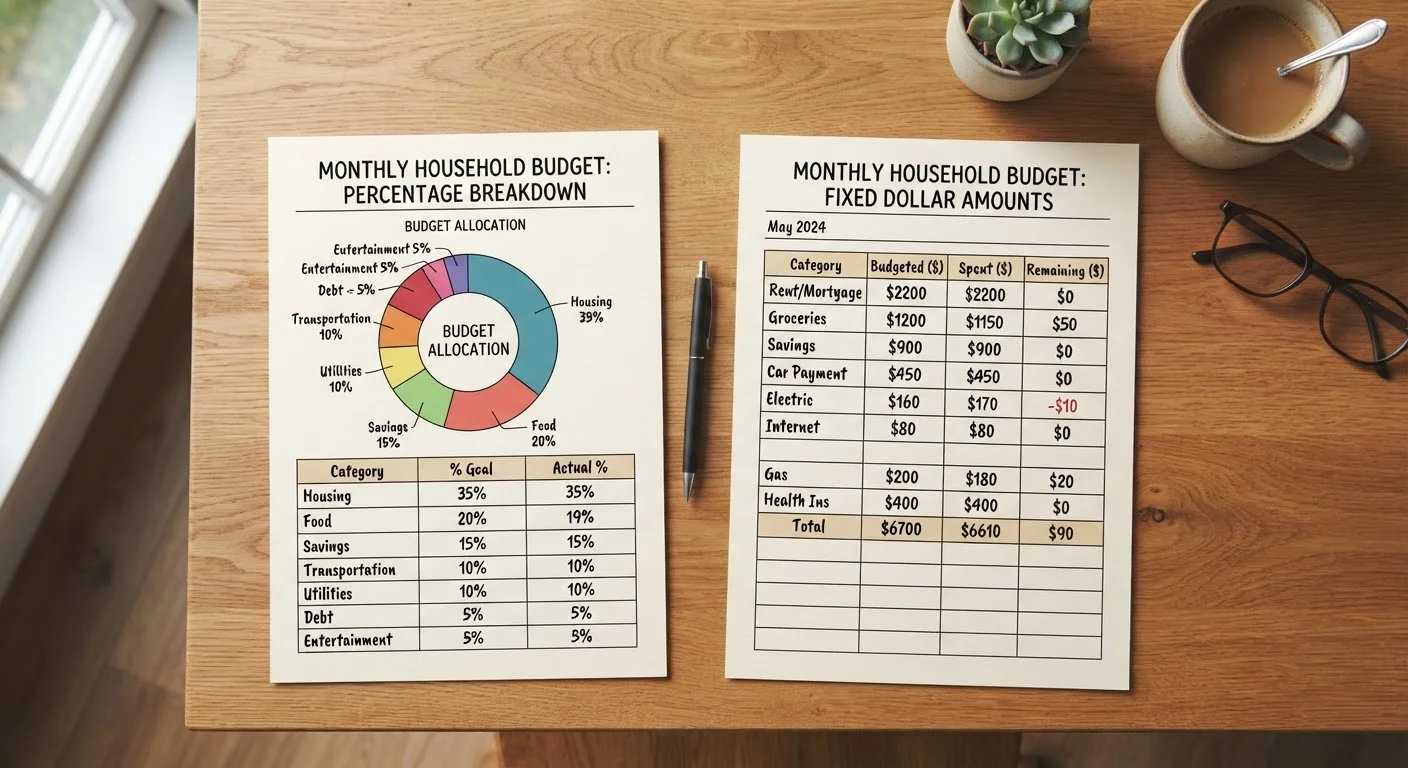
Photo: InsightsChief.com | Your Source Of Trusted Insights editorial
Key Takeaways
- Percentage-based budgets automatically scale when income rises or falls, making them more adaptable.
- Fixed-amount budgets offer predictability and simplicity, especially for households with stable incomes.
- Neither approach is universally superior - the right fit depends on income variability and household complexity.
- Hybrid approaches that combine both methods are common and often more practical than either alone.
- Any budget structure works better when built on foundational tracking habits first.
How Each Method Actually Works
A percentage-based budget allocates a share of your total monthly income to each spending category. For example, if a household earns $4,000 one month, 50% toward needs equals $2,000. If income drops to $3,200, needs spending automatically recalibrates to $1,600. The most widely referenced percentage framework is the 50/30/20 rule - covering needs, wants, and savings - though many households adjust those ratios to fit their reality.
A fixed-amount budget sets a hard dollar figure for each category regardless of what comes in. Groceries: $450. Utilities: $180. Entertainment: $80. The numbers don't move unless you consciously change them. This is how many households intuitively budget - they know what bills are due and cap discretionary spending from whatever's left.
The mechanical difference sounds minor, but it creates meaningfully different behaviors under financial pressure.
Where Percentage-Based Budgeting Has an Edge
The built-in flexibility of percentage budgeting makes it well-suited for households where income isn't the same every month - gig workers, freelancers, commission-based earners, or anyone who picks up irregular side income. When a lower-income month arrives, spending targets shrink automatically rather than creating an immediate shortfall.
Percentage budgeting also keeps savings proportional. If you commit 15% to savings and income increases, the savings dollar amount grows without you having to revisit the plan. This automatic scaling is one reason percentage frameworks tend to hold up better over time as circumstances change.
Start With What You Actually Spend
That said, percentages can obscure real affordability. A household earning $2,800 per month allocating 30% to wants has $840 to work with - but their fixed housing costs may already consume so much income that a standard percentage split simply doesn't map onto their actual situation. Percentages are guidelines, not guarantees of a workable budget.
Where Fixed-Amount Budgeting Has an Edge
Fixed-dollar budgeting is easier to execute week to week. You know exactly what you can spend on groceries before you walk into the store. You don't need to recalculate anything after a pay stub arrives. For households where income is consistent - salaried workers with predictable paychecks - this simplicity is genuinely valuable.
Fixed amounts also create clearer accountability. It's harder to rationalize an overage when you've written down a specific number. Many households find that the concreteness of a dollar cap curbs spending in ways a percentage does not, because percentages can feel abstract until the math is done.
| Percentage-Based | Fixed-Amount | |
|---|---|---|
| Adapts to income changes | Yes - automatically scales | No - requires manual revision |
| Ease of setup | Moderate - requires income tracking | Simple - set amounts once |
| Day-to-day clarity | Less concrete until calculated | High - dollar caps are explicit |
| Best income type | Variable or irregular income | Stable, predictable income |
| Savings discipline | Grows proportionally with income | Fixed regardless of earnings |
| Risk of breaking down | Lower during income swings | Higher when income drops suddenly |
The limitation surfaces when income changes. A fixed grocery budget of $400 looks different when a partner's hours are cut. The plan doesn't self-adjust - the household has to manually revisit every category, which many skip under stress. This rigidity is one reason fixed-amount budgets can quietly break down during income volatility without anyone noticing until a shortfall hits.
For more detail on how different budgeting systems compare in day-to-day practice, this side-by-side breakdown of budgeting methods covers execution differences across several common approaches.
Mixing Both Approaches: A Practical Middle Ground
In practice, most functional household budgets blend the two. Fixed amounts work well for committed expenses that don't move month to month - rent or mortgage, loan minimums, insurance premiums, utilities. Percentages work better for discretionary and savings categories where flexibility matters.
For instance: set a firm $1,350 for housing because that's what the lease says, a firm $220 for loan payments, and then apply a 10% savings target and a 15% cap on discretionary spending based on whatever income arrives that month. This hybrid approach reflects budgeting principles that hold across income levels - anchoring the non-negotiables while keeping flexible categories responsive to reality.
Whichever structure you use, the foundation is the same: track where money is actually going before you assign it anywhere. A budget structure imposed on unexamined spending rarely holds. If you're evaluating a more intensive approach, zero-based budgeting assigns every dollar a purpose before the month begins and may complement either method.
This article is for general informational and educational purposes only. It does not constitute personalized financial advice. Consult a qualified financial professional for guidance specific to your situation.
The content provided on our blog site traverses numerous categories, offering readers valuable and practical information. Readers can use the editorial team’s research and data to gain more insights into their topics of interest. However, they are requested not to treat the articles as conclusive. The website team cannot be held responsible for differences in data or inaccuracies found across other platforms. Please also note that the site might also miss out on various schemes and offers available that the readers may find more beneficial than the ones we cover.