
Envelope Budgeting vs. Digital Spending Limits: Two Systems Compared

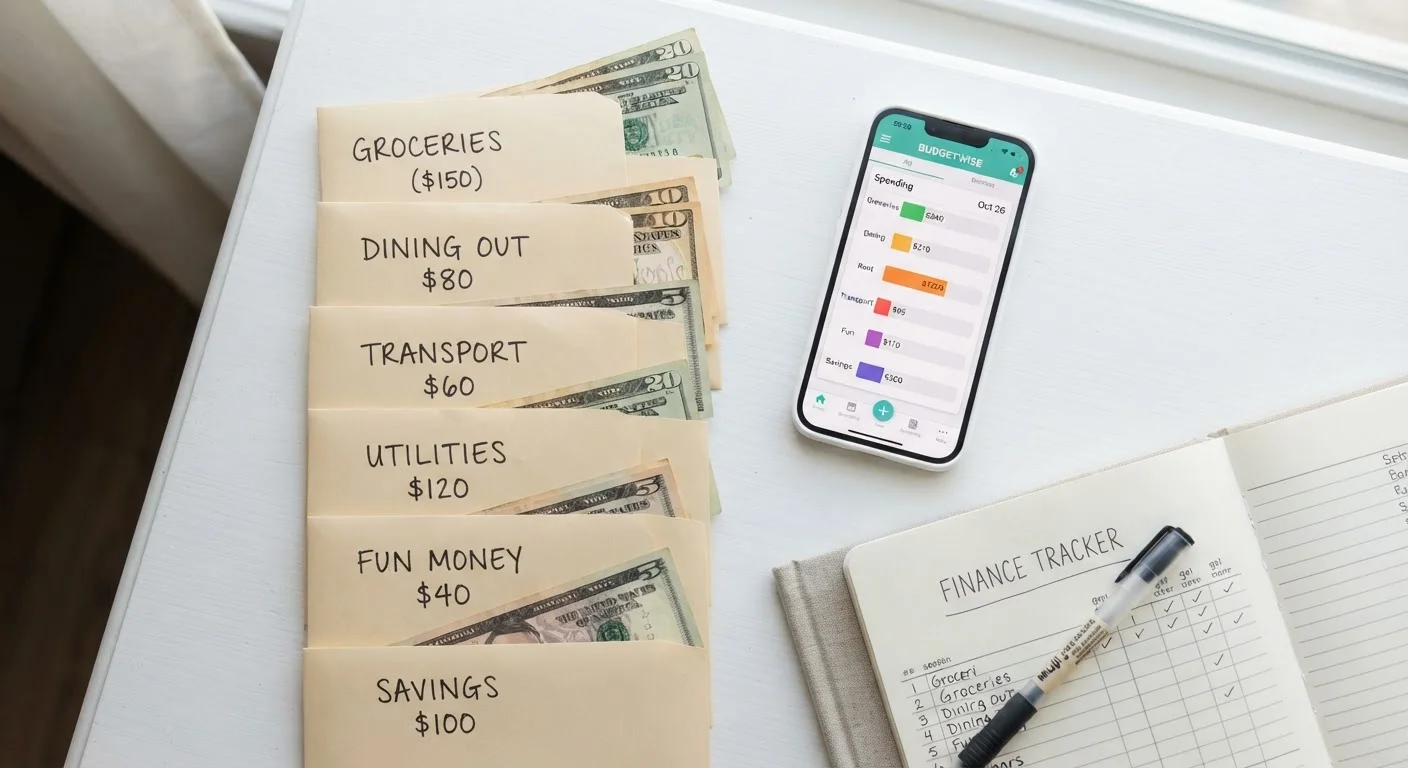
Photo: InsightsChief.com | Your Source Of Trusted Insights editorial
Key Takeaways
- Envelope budgeting uses physical cash to create hard spending limits per category each pay period.
- Digital spending limits set category caps inside budgeting apps, tracking card and bank transactions automatically.
- Cash envelopes eliminate overspending by design; digital limits rely on the user to heed app alerts.
- Digital systems work seamlessly with cashless payments but require consistent bank sync and attention.
- Neither system is universally better - the right fit depends on spending habits and self-discipline style.
- Both methods work best when paired with a clear picture of monthly income and fixed expenses.
How Each System Actually Works
Understanding what each method does mechanically helps you predict how it will behave in your real household - not just in theory.
Envelope budgeting works by withdrawing cash at the start of each pay period and physically dividing it into labeled envelopes - one for groceries, one for gas, one for dining out, and so on. When an envelope is empty, that category's spending stops until the next pay period. No digital tool, no notification - just an empty envelope. The friction is the feature.
Digital spending limits work inside a budgeting app. You set a dollar cap for each spending category, link your bank accounts and cards, and the app automatically imports transactions and tracks your remaining balance in each category. When you approach or hit a cap, you get an alert - but the card still works. Stopping is a choice.
For a broader look at how these and other methods compare side by side, see Cash Envelopes, Spreadsheets, and Apps. And if foundational budgeting vocabulary is unfamiliar, Key Budgeting Terms Every Household Should Know is a practical starting point.
| Criterion | Envelope Budgeting | Digital Spending Limits |
|---|---|---|
| Spending medium | Cash only | Cards, bank accounts, digital payments |
| How limits are enforced | Hard stop - empty envelope | Soft stop - alert or notification |
| Setup effort | Low - withdraw cash, label envelopes | Moderate - link accounts, configure categories |
| Ongoing maintenance | Low - spend and track manually | Low to moderate - review sync accuracy |
| Works with subscriptions | No - requires workaround | Yes - auto-imported transactions |
| Partner visibility | Limited - shared envelopes needed | High - shared dashboard access |
| Overspend risk | Very low - cash runs out | Moderate - alerts can be dismissed |
| Security considerations | Physical cash loss risk | Account security, data privacy |
Where Each System Breaks Down
No budgeting method is frictionless, and knowing the failure points of each system prevents unnecessary frustration.
Envelope budgeting gets complicated when most of your spending is digital. Subscription services, online purchases, and automatic bill payments don't pull from a physical envelope. Many households run hybrid systems - cash envelopes for variable discretionary spending (groceries, entertainment, personal care) and separate digital tracking for fixed costs - but this adds management overhead. Carrying cash also involves minor security risk and inconvenience.
Digital spending limits fail when the alerts are ignored. Apps can only surface information; they cannot stop a transaction. If a household routinely dismisses warnings and continues spending, the limits become decorative. Sync delays - where a transaction doesn't appear for a day or two - can also cause category balances to look rosier than they are, leading to accidental overspending.
~33%
Americans with no monthly budget
NFCC (National Foundation for Credit Counseling) consumer surveys have consistently found that roughly one in three U.S. adults does not follow any formal budget.
~60%
US adults living paycheck to paycheck
Multiple consumer finance surveys, including those from LendingClub, have found that around 60% of Americans report spending most or all of their monthly income.
3-4 weeks
Typical adjustment period for new budget
Personal finance practitioners generally observe that it takes two to four pay cycles to calibrate category spending limits to realistic household patterns.
Both systems also share a universal weakness: they only control discretionary categories. Fixed expenses like rent, utilities, and loan payments sit outside either framework. That's why foundational budgeting principles - knowing your real income and fixed costs before setting any limits - matter regardless of which method you choose.
Choosing the Right Fit for Your Household
The honest answer is that the better system is the one you will actually maintain. Both have strong track records when used consistently.
Start by asking one question: Do you overspend because you lose track of what you've spent, or because you spend impulsively even when you know the balance? If it's the former, digital spending limits - with automatic tracking - often solve the core problem. If it's the latter, the hard stop built into cash envelopes tends to be more effective because awareness alone isn't the issue.
Households where partners have different spending styles sometimes find value in a hybrid: digital limits for shared categories (groceries, household) where both need visibility, and envelope cash for individual discretionary money. This structure also works well when you're deciding between percentage-based versus fixed-amount category allocations - the method you use to divide money is separate from the tool you use to track it.
Whichever system you start with, give it at least two full pay periods before judging it. The first cycle is always rougher as category amounts get calibrated to reality. The goal is not a perfect budget on paper - it's a budget that changes your actual spending behavior.
This article is for general informational and educational purposes only and does not constitute personalized financial advice. For guidance specific to your household situation, consult a qualified financial professional.
The content provided on our blog site traverses numerous categories, offering readers valuable and practical information. Readers can use the editorial team’s research and data to gain more insights into their topics of interest. However, they are requested not to treat the articles as conclusive. The website team cannot be held responsible for differences in data or inaccuracies found across other platforms. Please also note that the site might also miss out on various schemes and offers available that the readers may find more beneficial than the ones we cover.