
Laminate, Hardwood, and Vinyl Plank Flooring Compared

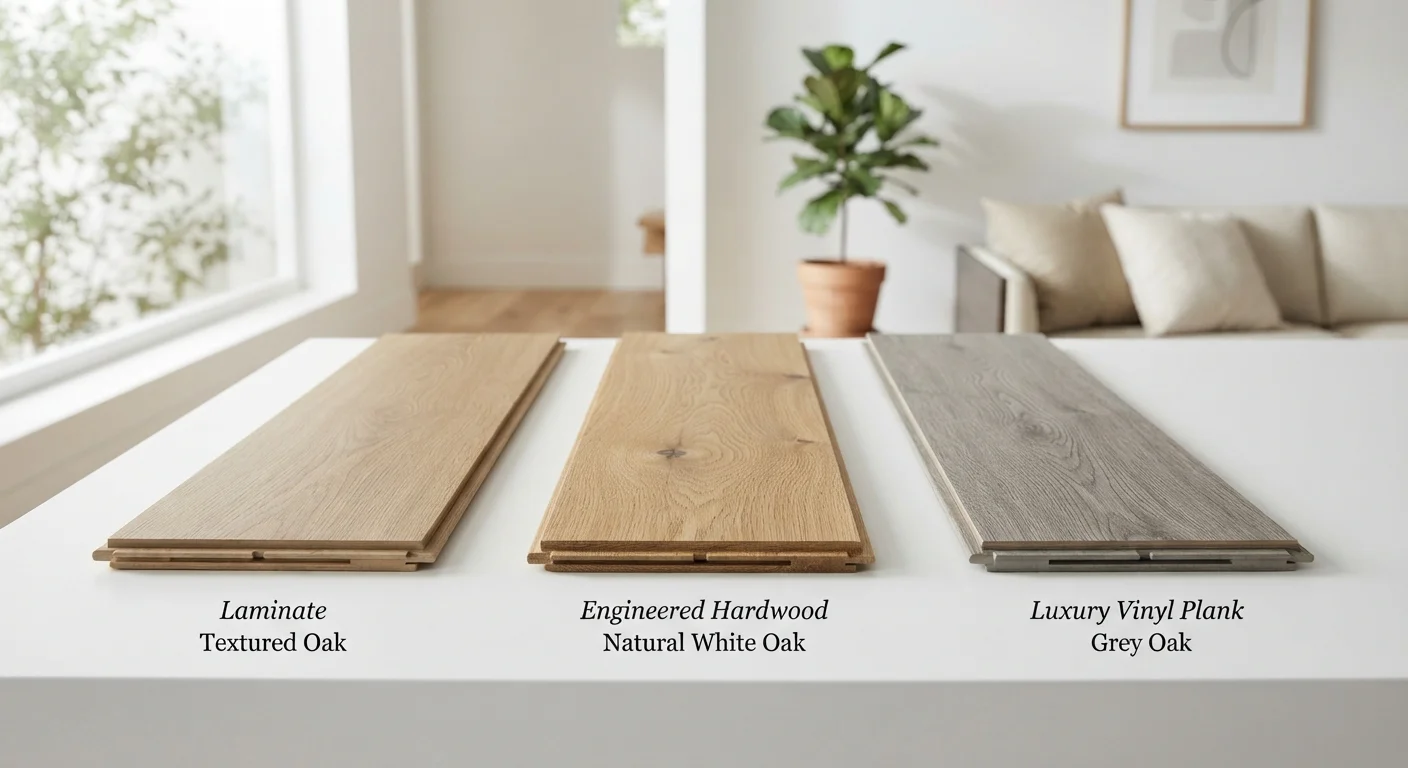
Photo: InsightsChief.com | Your Source Of Trusted Insights editorial
Key Takeaways
- Vinyl plank flooring leads in moisture resistance, making it suitable for bathrooms and basements.
- Solid hardwood offers the longest lifespan and can be sanded and refinished multiple times.
- Laminate provides the most budget-friendly entry point while still mimicking a wood appearance.
- All three options are achievable DIY projects, though hardwood installation demands more skill.
- Local humidity, subfloor condition, and room use should drive your flooring choice.
What Each Flooring Type Actually Is
Understanding what these materials are made of helps explain their performance differences - and their price gaps.
- Laminate flooring is a multi-layer synthetic product. Its core is typically high-density fiberboard (HDF), topped with a photographic layer that mimics wood or stone, sealed beneath a clear wear layer. It is not wood, but it can look convincingly similar.
- Hardwood flooring comes in two forms: solid hardwood (a single piece of real wood, typically ¾ inch thick) and engineered hardwood (real wood veneer bonded over a plywood core). Both contain genuine wood, giving them a warmth and authenticity the others cannot fully replicate.
- Luxury vinyl plank (LVP) is a fully synthetic product built from polyvinyl chloride (PVC) layers. Its rigid core construction - common in products labeled WPC (wood-plastic composite) or SPC (stone-plastic composite) - makes it dimensionally stable and highly water resistant.
These construction differences cascade directly into each material's durability, moisture performance, and how it responds to temperature and humidity fluctuations over time.
Side-by-Side Comparison
The table below compares laminate, hardwood, and vinyl plank across the criteria that matter most to budget-conscious homeowners tackling a renovation.
| Laminate | Hardwood | Vinyl Plank | |
|---|---|---|---|
| Moisture Resistance | Low - swells when wet | Low to moderate | High - fully waterproof core |
| Typical Lifespan | 15-25 years | 50-100 years (with refinishing) | 15-25 years (non-refinishable) |
| Refinishable | No | Yes - multiple times | No |
| DIY Installation Difficulty | Easy (click-lock float) | Moderate to hard | Easiest (click-lock float) |
| Approximate Material Cost | $1-$5 per sq ft | $3-$15 per sq ft | $2-$7 per sq ft |
| Feels Underfoot | Hollow sound, firm | Solid, warm, authentic | Slightly softer, quieter |
| Best Room Fit | Dry living areas | Living rooms, bedrooms | Any room including wet areas |
A few important notes on what the table doesn't capture: hardwood's refinishing capability dramatically extends its usable life, while vinyl plank's 100% waterproof core is a category advantage none of the others can match. Laminate, despite its lower cost, can swell irreparably when exposed to standing water.
Durability and Long-Term Wear
Durability varies meaningfully across these three materials - and the type of wear matters as much as the rating.
Hardwood is susceptible to scratches, dents, and moisture damage when unprotected, but its ability to be sanded and refinished (typically 3-5 times for solid hardwood) means it can look new again after decades of use. A properly maintained hardwood floor can last 50-100 years. Engineered hardwood offers more dimensional stability in fluctuating climates but can typically only be refinished once or twice depending on veneer thickness.
Vinyl plank resists scratches and dents better than laminate in most real-world conditions, particularly the thicker SPC core options. However, it cannot be refinished - once worn through, it must be replaced. Quality matters here: wear layer thickness, measured in mils, ranges from around 6 mils (light residential) to 40+ mils (commercial grade).
Laminate performs well under moderate foot traffic but is vulnerable at its seams. If moisture infiltrates the joints, the HDF core swells - damage that is typically irreversible. Its lifespan in a well-maintained, dry interior is generally 15-25 years.
Test Your Subfloor Before Buying
Installation Difficulty and DIY Feasibility
All three flooring types are marketed as DIY-friendly, but they differ in the skill and tools required.
Vinyl plank is widely considered the most beginner-friendly option. Most products use a click-lock floating installation that requires no adhesive and no nailing. Its flexibility also means minor subfloor imperfections are less problematic, though manufacturers typically specify that the subfloor should be level within ¼ inch over 10 feet.
Laminate installs similarly using a floating click-lock method and is also accessible to most DIYers. It is lighter and slightly easier to cut than SPC vinyl plank. Like vinyl plank, it requires expansion gaps along walls to accommodate seasonal movement.
Hardwood - particularly solid hardwood - is the most demanding. It typically requires nail-down or staple-down installation using a flooring nailer, acclimatization to the home's humidity levels for several days before installation, and greater precision in cutting and layout. Engineered hardwood is somewhat more forgiving and can sometimes be floated or glued, but still demands more skill than either vinyl or laminate. Mistakes in hardwood installation are more costly to correct.
For any installation, proper subfloor preparation is the most commonly overlooked step. A flat, clean, structurally sound subfloor is essential regardless of which material you choose.
Cost Considerations
Flooring costs vary by region, product grade, and whether you hire out the labor. The figures below represent general ranges for material costs - they are not guarantees, and local pricing will differ.
- Laminate: Generally the lowest material cost, often ranging from roughly $1 to $5 per square foot for the flooring itself. Entry-level options are widely available.
- Vinyl plank: Mid-range material pricing, typically $2 to $7 per square foot, with premium SPC products at the higher end. Durability and waterproofing often justify the modest premium over laminate.
- Hardwood: The widest price range of the three. Engineered hardwood commonly runs $3 to $10 per square foot; solid hardwood can range from $5 to $15 or more depending on species. Add professional installation - often $3 to $5 per square foot - and the total cost difference versus DIY vinyl plank can be substantial.
Factor in underlayment (often required for laminate and some vinyl), transitions, trim, and waste allowance (typically 10% for straight layouts, more for diagonal or herringbone patterns) when budgeting any project.
The content provided on our blog site traverses numerous categories, offering readers valuable and practical information. Readers can use the editorial team’s research and data to gain more insights into their topics of interest. However, they are requested not to treat the articles as conclusive. The website team cannot be held responsible for differences in data or inaccuracies found across other platforms. Please also note that the site might also miss out on various schemes and offers available that the readers may find more beneficial than the ones we cover.